.Li-Fi Technology Explained – The Future of Wireless Internet, The world is perpetually chasing faster, more reliable, and more secure ways to connect. As our reliance on data grows exponentially, the limitations of traditional radio-frequency (RF) communication, like Wi-Fi, are becoming apparent. Enter Li-Fi Technology, an innovative solution poised to revolutionize how we access the internet. Often dubbed Light Fidelity technology explained (Li-Fi), this groundbreaking concept utilizes visible light waves to transmit data, offering a potential paradigm shift in wireless communication.
What is Li-Fi Technology?
What is Li-Fi technology? Simply put, it’s a two-way, high-speed, fully networked wireless communication technology that uses light, rather than radio waves, to transmit data. It was first conceived and demonstrated by German physicist Harald Haas in 2011, who coined the term.
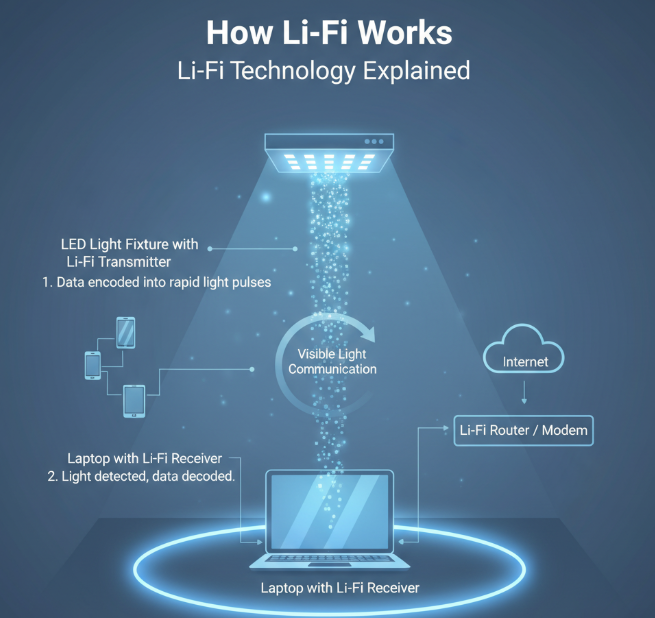
Unlike Wi-Fi, which relies on RF signals that are often congested and limited, Li-Fi uses the Visible Light Spectrum (VLS). Every LED light bulb can essentially be turned into a high-speed router. Data is encoded into the light by rapidly varying the intensity of the LED at speeds imperceptible to the human eye. This rapid switching between on and off states (or varying light intensity) transmits the data. This core principle makes Li-Fi an incredibly efficient form of Li-Fi internet technology.
How Li-Fi Works: The Science of Data Through Light
Understanding how Li-Fi works is key to appreciating its potential. The core infrastructure relies on LED lights equipped with signal processing technology.
- Transmission: Data is first converted into a digital signal. This signal is then fed into an LED light bulb driver, which modulates the intensity of the light at extremely high speeds (millions of times per second).
- Propagation: The light, now carrying the encoded data, travels across the visible spectrum. Since these changes in intensity are so fast, the light appears constant to the human eye.
- Reception: A photodetector (or photodiode) on the receiving device (like a laptop or smartphone) captures the changes in light intensity.
- Decoding: The photodetector converts these light variations back into an electrical current, which is then processed back into the original digital data.
This process is the secret behind how Li-Fi technology transmits data using light. It offers a vast, untapped, and unlicensed spectrum compared to the overcrowded radio spectrum.
Li-Fi vs Wi-Fi: A Comparative Analysis
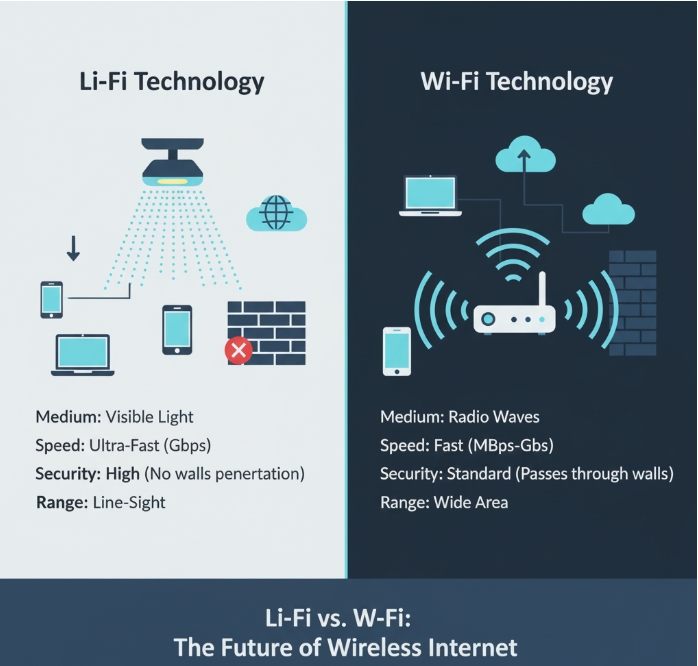
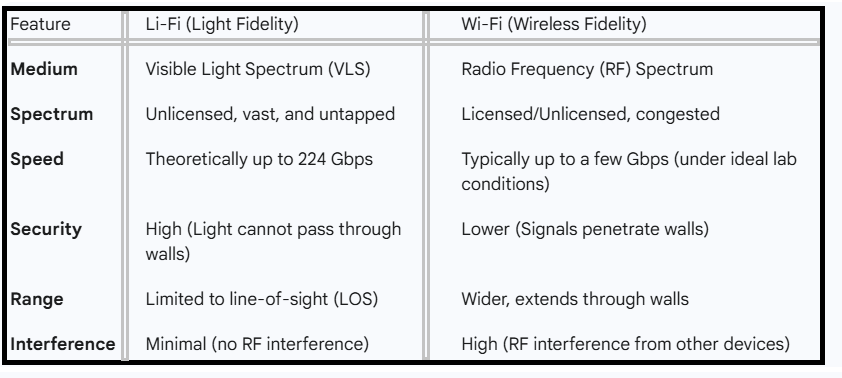
The most natural comparison for Li-Fi Technology is its radio-frequency counterpart, Wi-Fi. While Wi-Fi has served us well, its limitations in terms of speed, density, and security are driving the need for alternatives. This brings us to the crucial discussion: is Li-Fi faster than Wi-Fi?
Advantages and Disadvantages of Li-Fi Technology
The advantages of Li-Fi technology are compelling, particularly in environments demanding high throughput and robust security.
The Advantages of Li-Fi
- Immense Speed: Li-Fi has demonstrated lab speeds far exceeding Wi-Fi, making it a powerful contender for the future of Li-Fi technology. Benefits of using Li-Fi for high-speed internet are obvious, allowing for instantaneous data transfers and 4K video streaming without lag.
- Enhanced Security: Since light cannot pass through opaque walls, the data transmission is confined to the physical room. This answers the question of how Li-Fi technology can improve data security, making interception virtually impossible without being physically present.
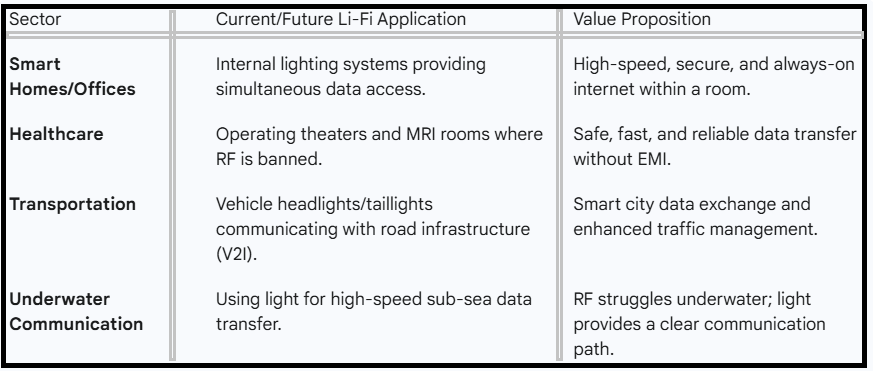
- No Electromagnetic Interference (EMI): Li-Fi can be used in sensitive areas where RF transmissions are restricted, such as hospitals, aircraft cabins, and power plants, as it does not interfere with other electronic devices.
- Alleviating RF Spectrum Congestion: By using the VLS, Li-Fi offloads data traffic from the increasingly strained RF spectrum.
The Disadvantages of Li-Fi
While the upsides are significant, there are limitations. The main drawback is the requirement for line-of-sight (LOS), meaning the light source and receiver must have a clear path. Furthermore, Li-Fi does not work in total darkness and is subject to external light interference (though sophisticated filtering can mitigate this). This consideration must be weighed in the overall assessment of advantages and disadvantages of Li-Fi technology.
Li-Fi Applications and Future Scope
The potential Li-Fi applications and future scope are vast and diverse. This innovation is not intended to replace Wi-Fi entirely but rather to complement it, creating an integrated, superior wireless ecosystem.
The Global Adoption of Li-Fi Technology
As the technology matures, we are seeing increasing efforts in standardization and commercialization. Companies are developing Li-Fi enabled LED fixtures and dedicated dongles. The next step involves integrating Li-Fi chips directly into smartphones and laptops, making the switch seamless. The development of hybrid Li-Fi and Wi-Fi networks will be critical in driving widespread adoption, ensuring connectivity whether a device is in the line-of-sight of a light source or not. The implementation of Li-Fi Technology in everyday lighting infrastructure holds the key to a universally connected and efficient future.
Frequently Asked Questions (FAQ)
Q1: Is Li-Fi commercially available now?
A: Yes, Li-Fi is commercially available from several companies, primarily for specialized, high-security, or high-density network applications. Widespread consumer integration (like built-in phone chips) is still in the early stages but is rapidly progressing.
Q2: Do I need special light bulbs for Li-Fi?
A: Yes, you need LED light bulbs that are equipped with a Li-Fi chipset and signal processing technology to encode the data into the light. These fixtures replace standard bulbs.
Q3: Will Li-Fi work if the light is dim?
A: Yes. Li-Fi relies on the rapid modulation of light intensity, not the overall brightness. Data transmission can continue even when the light is dimmed to a level barely visible to the human eye, provided the light is not completely off.