Difference Between Quantum SEO Vs Generative Engine Optimization. The world of Search Engine Optimization (SEO) is on the brink of a massive transformation, moving far beyond the traditional metrics of keywords and backlinks. The emergence of artificial intelligence (AI) and the theoretical application of advanced computing models are introducing two revolutionary concepts: Generative Engine Optimization (GEO) and Quantum SEO. While both are geared towards future-proofing digital visibility, their scope, mechanisms, and implementation are fundamentally distinct. Understanding the core Difference Between Quantum SEO Vs Generative Engine Optimization is critical for any marketer or business aiming to maintain authority in the next evolution of search.
:Difference Between Quantum SEO Vs Generative Engine Optimization:
What is Generative Engine Optimization (GEO)?
Generative Engine Optimization (GEO) is a contemporary practice focused on enhancing a content’s visibility and influence within search experiences powered by generative AI, the systems that synthesize information into direct, summarized answers rather than simply listing links. Platforms like Google’s AI Overviews, ChatGPT, Perplexity, and Gemini all represent this shift to an answer engine model.
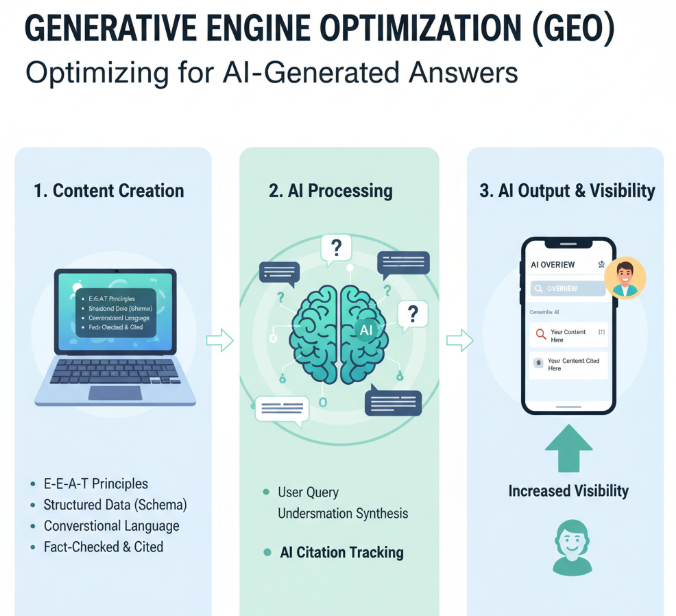
Key Focus and Strategies of Generative Engine Optimization
The primary goal of GEO is to ensure your content is the source that the Large Language Model (LLM) cites, quotes, or incorporates into its generated summary. It’s a direct response to the zero-click search phenomenon.
Generative Engine Optimization techniques and strategies revolve around a deeper emphasis on content quality, structure, and factual authority:
- Prioritizing E-E-A-T (Experience, Expertise, Authoritativeness, and Trustworthiness): GEO demands content that is demonstrably written by or reviewed by experts, providing reliable and cited information. Incorporating expert quotations and verifiable statistics and factual evidence are no longer optional but essential.
- Structuring for AI Retrieval: Content must be clearly structured with descriptive headings (like an FAQ format), bulleted lists, and concise paragraphs. This structured content is easy for the LLM to process, extract, and synthesize into a coherent answer. Semantic markup, such as Schema.org for Q&A, products, or reviews, is paramount for machine readability.
- Conversational and Contextual Language: GEO aligns with natural language processing (NLP) models, meaning the content should address complex, conversational queries in a natural, human-like tone, moving beyond simple keyword-based ranking. This is How Generative Engine Optimization changes SEO—it pushes optimization from mere matching to deep understanding of user intent.
In essence, GEO is the process of optimizing content specifically for AI-driven platforms, which is why it’s a vital part of a modern SEO strategy.
What is Quantum SEO and How it Works?
Quantum SEO is a far more advanced, largely theoretical, or quantum-inspired concept that aims to transform the optimization process itself by leveraging the principles of quantum computing and advanced machine learning. Unlike GEO, which focuses on content output for AI, Quantum SEO focuses on process input—the dynamic, real-time optimization of massive data sets. What is Quantum SEO and how it works boils down to applying ideas like superposition and entanglement to solve extremely complex, combinatorial SEO problems that traditional computers struggle with.
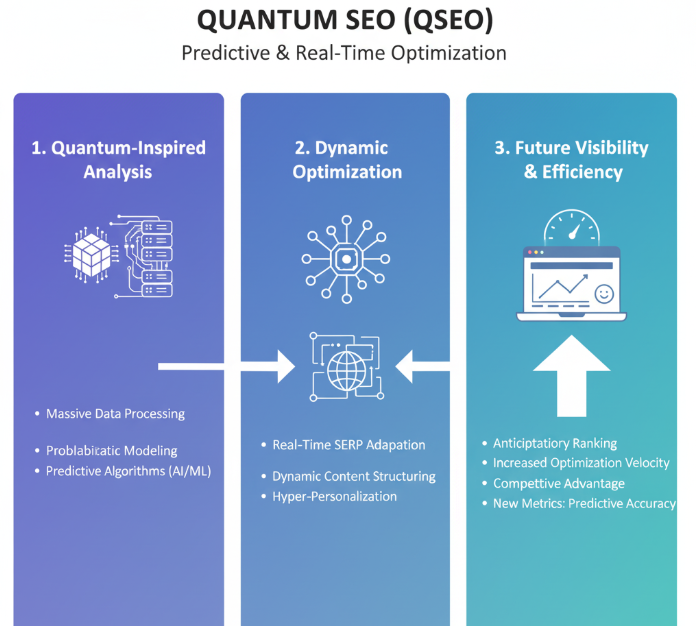
Quantum SEO Techniques and Strategies
While true quantum computing for SEO is still in its infancy, “quantum-inspired” approaches using powerful AI are beginning to emerge. Quantum SEO techniques and strategies are characterized by predictive modeling and hyper-efficient data analysis:
- Predictive User Behavior Modeling: Quantum-inspired algorithms can analyze a staggering number of variables simultaneously—user history, device, location, time, and search patterns—to predict what a user will search for next. This allows for real-time SERP adaptation and content optimization before a trend hits.
- Semantic Mapping over Keyword Research: Quantum SEO evolves keyword research into a process of semantic mapping. It analyzes the complex, multi-dimensional relationships between all content on a site and all related search terms, optimizing for holistic topic authority rather than individual keywords.
- Dynamic Internal Linking (Entanglement): Borrowing the concept of entanglement from quantum physics, this approach models a website’s internal link structure as a system where every page’s authority is mathematically connected to every other page. This results in dynamic link mapping that ensures optimal authority flow across the entire site instantly.
The core distinction is that Quantum SEO and Generative Engine Optimization address different parts of the search equation: GEO is about making your content a high-quality, authoritative source for the AI to read, whereas Quantum SEO is about using cutting-edge technology to make your entire site structure and optimization process smarter and faster than your competitors.
The Core Difference Between Quantum SEO Vs Generative Engine Optimization
The Difference Between Quantum SEO Vs Generative Engine Optimization can be segmented into three core areas: the Target System, the Primary Focus, and the Technological Basis.
Key Distinctions in Focus and Target

While GEO is a set of strategies you can implement today, Quantum SEO vs traditional SEO represents a conceptual leap to the future of SEO with Quantum Computing, where optimization is dynamic and probabilistic.
Strategic Implementation: Complementary or Competing?
Marketers should view Quantum SEO and Generative Engine Optimization not as competing but as complementary forces that will eventually merge into a cohesive digital strategy.
Generative Engine Optimization Techniques and Strategies
For immediate impact, focus on solid GEO practices:
- Become the Answer: Create clear, concise, and factual content that answers the People Also Ask and other related questions directly. Use Q&A Schema to tag these answers.
- Demonstrate Authority: Every article should include verifiable citations, links to authoritative sources, and clear author profiles that showcase relevant expertise. This is crucial for gaining the AI’s trust.
- Depth and Context: Move away from thinly veiled keyword-stuffing. GEO rewards contextual depth. Create topical clusters that comprehensively cover a subject.
Quantum SEO and Generative Engine Optimization: The Synergy
The true power lies in the overlap. Imagine a scenario where a quantum-inspired AI tool (QSEO) analyzes millions of user-intent combinations in real-time, predicting that users in a specific region are about to start asking a highly complex, multi-layered question. This predictive insight then informs your content team to immediately create a new, perfectly structured, E-E-A-T-optimized article (GEO) to become the source for the inevitable AI-generated answer.
In this context, GEO is the quality-focused action on the content, while Quantum SEO is the real-time, predictive intelligence driving the content strategy. The Difference Between Quantum SEO Vs Generative Engine Optimization dissolves when one is used to power the other.
Tactical Differences and Future Metrics
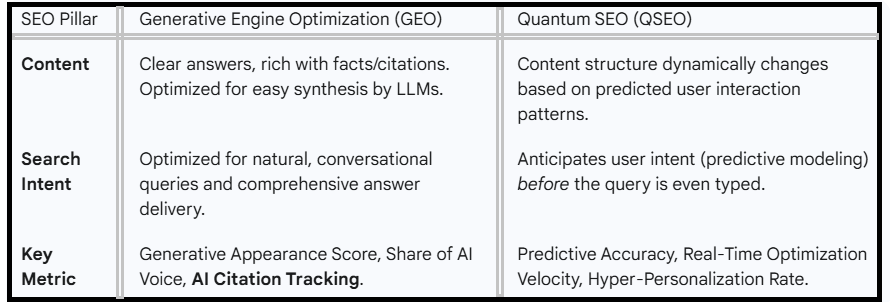
The Future Trajectory of Search
As search engines, including Google, continue to integrate more generative AI features, GEO will transition from a specialized technique to an indispensable part of Generative Engine Optimization techniques and strategies in modern SEO. Simultaneously, the concepts behind Quantum SEO—specifically, using advanced machine learning to handle unprecedented data complexity—will become the backbone of enterprise-level SEO software, dictating high-level strategy and technical optimization at scale.
The Future of SEO with Quantum Computing isn’t about replacing human strategists; it’s about providing them with tools of near-instantaneous, multi-variable analysis to outmaneuver the competition. For now, mastering Generative Engine Optimization is the crucial step to securing visibility in the AI-first search world.
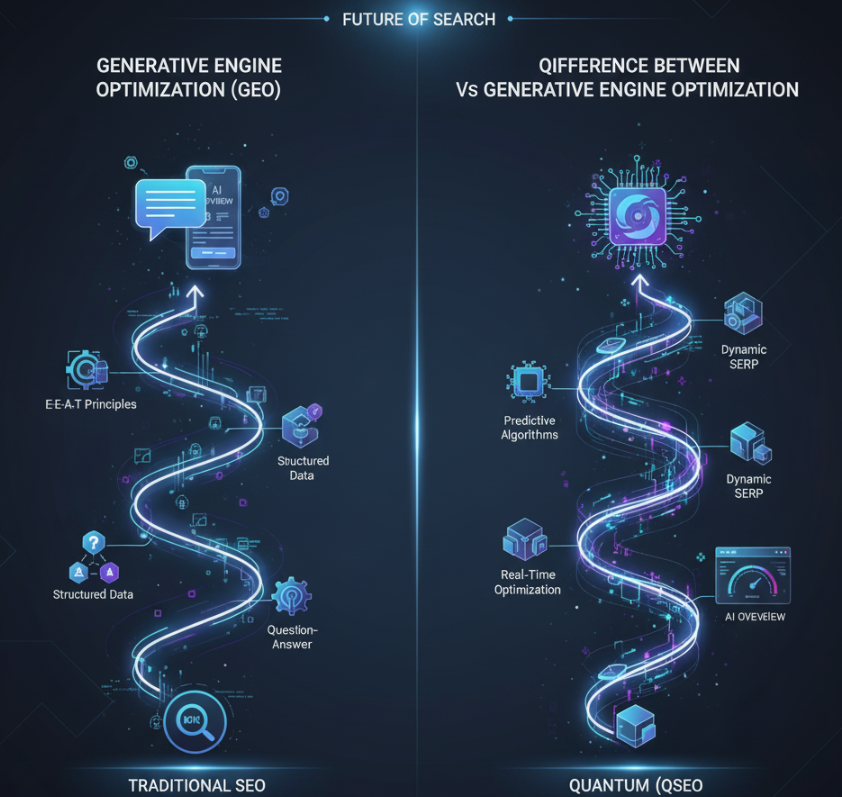
Evolution of Optimization Focus

Frequently Asked Questions
Is Quantum SEO currently a widely adopted practice?
Quantum SEO is largely a conceptual framework or a term for quantum-inspired optimization, meaning it uses advanced, massive-scale AI and predictive algorithms, drawing analogies from quantum computing principles. True quantum computing for SEO is not yet a mainstream practice due to hardware limitations, but its concepts are driving the next generation of predictive SEO tools.
What is the most immediate priority for content creators: GEO or QSEO?
Generative Engine Optimization is the immediate priority. The shift to AI-generated answers (like Google’s AI Overviews) is already here. Optimizing your content for citation and E-E-A-T is necessary right now to maintain brand visibility.
How is Generative Engine Optimization different from traditional SEO?
How Generative Engine Optimization changes SEO is that it shifts the focus from ranking pages (which traditional SEO targets) to becoming the trusted source that an AI uses to generate an answer. Traditional SEO is about clicks to your page; GEO is about your content being the direct answer presented to the user.