Blockchain for Automotive Cybersecurity: The Future of Secure Mobility. The automobile industry is accelerating toward hyper-connected smart mobility. Vehicles today communicate with cloud servers, road infrastructure, and other cars. Electric vehicles, autonomous systems, and over-the-air updates are becoming standard. With this digital transformation comes a massive challenge: safeguarding vehicles from cyberattacks. This is where Blockchain for Automotive Cybersecurity emerges as one of the most promising solutions to protect modern mobility systems.
Cybersecurity threats in the automotive industry are no longer sci-fi scenarios. Hackers can remotely unlock car doors, manipulate ECUs, disable brakes, alter telematics data, or compromise navigation systems. As vehicles evolve into rolling computers, centralized security frameworks struggle to keep up. Blockchain, with its decentralized and tamper-proof architecture, offers a revolutionary defense layer for connected and autonomous transportation.
Why Blockchain for Automotive Cybersecurity Matters
Modern automotive systems rely on constant data exchange across sensors, V2X communication (vehicle-to-everything), infotainment units, charging networks, and cloud platforms. Any breach in this ecosystem can lead to catastrophic safety risks.
Implementing Blockchain for Automotive Cybersecurity ensures:
• Immutable storage of vehicle and sensor data
• Verified communication between connected devices
• Tamper-proof update distribution
• Transparent access logs
• Reduced single-point failure risks through distributed security
This approach creates a secure digital trust network for vehicles, manufacturers, fleet operators, and service providers.
How Blockchain Enhances Automotive Cybersecurity
Blockchain brings a unique model of cyber defense using distributed ledger technology. Instead of relying on a central security authority, blockchain distributes data across a decentralized network. This makes unauthorized access or data manipulation nearly impossible.
It provides:
• Decentralized automotive data security
• Verified digital identity for vehicles and components
• Cryptographic validation for vehicle-to-vehicle communication
• Secure over-the-air updates
• Real-time authentication of software and firmware
This is exactly How blockchain enhances automotive cybersecurity in smart mobility ecosystems.
Traditional vs Blockchain-Based Automotive Security
| Security Feature | Traditional Automotive Security | Blockchain-Enabled Security |
|---|---|---|
| Data Storage | Centralized servers | Distributed & decentralized |
| Vulnerability | Higher risk of data manipulation | Near-impossible tampering |
| Software Updates | Manufacturer-controlled | Cryptographically verified |
| Attack Surface | Single point of failure | Network-wide protection |
| Transparency | Limited | Full traceability & logging |
Blockchain turns every communication and update into a verifiable transaction, ensuring maximum data integrity.
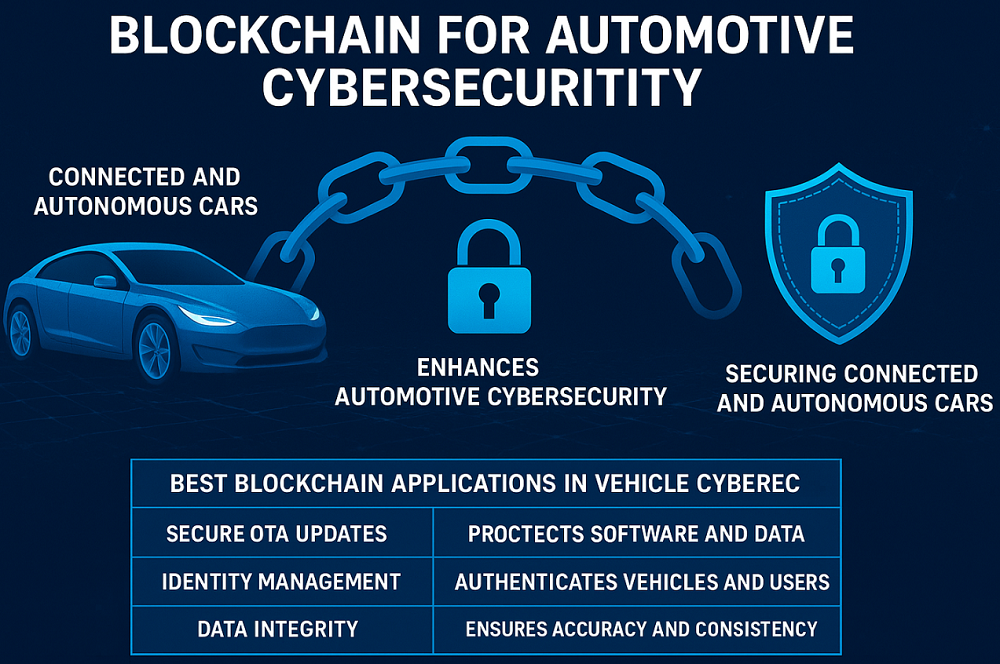
Best Blockchain Applications in Vehicle Cybersecurity
The Best blockchain applications in vehicle cybersecurity go beyond securing communication networks. They include:
- Secure vehicle-to-vehicle (V2V) and vehicle-to-infrastructure (V2I) communication
- Tamper-proof event data recording
- Digital identity verification for cars and components
- Secure charging and billing for EVs
- Authentic OTA firmware updates
- Smart contract-based access control
- Telematics and fleet management security
This roadmap showcases how decentralized automotive networks can create a zero-trust cybersecurity architecture.
Blockchain for Securing Connected and Autonomous Cars
Autonomous vehicles rely heavily on AI, sensors, cloud analytics, and digital maps. A single software breach could compromise thousands of cars. That is why Blockchain for securing connected and autonomous cars has become a necessity in future mobility systems. Blockchain ensures every AI decision, sensor input, and route data packet is verified.
This also aligns with blockchain for autonomous vehicle protection, safeguarding AI-powered mobility systems from tampering and malicious interference.
Blockchain Security Benefits for Autonomous Vehicles
| Autonomous System | Cyber Risk | Blockchain Security Advantage |
|---|---|---|
| Sensor Fusion | Fake sensor data injection | Validated sensor trust layer |
| AI Driving Decisions | Algorithm manipulation | Data integrity verification |
| Navigation Systems | GPS spoofing | Crypto-secured map transactions |
| OTA Updates | Firmware hacking | Immutable update verification |
| Fleet Communication | Remote hijacking | Encrypted authenticated nodes |
Blockchain becomes a digital shield ensuring autonomous mobility remains trusted and safe.
Blockchain Vehicle Cybersecurity Solutions in Real-World Use Cases
Despite being a relatively young technology, blockchain vehicle cybersecurity solutions are already entering the automotive ecosystem. Leading automakers and cybersecurity companies are developing systems to protect fleet networks, telematics, EV charging, and autonomous driving platforms.
Use case examples include:
• Distributed logging for crash investigation
• Cryptographic keys for vehicle access systems
• Blockchain-secured EV charging transactions
• Real-time software integrity monitoring
• Protection of digital IDs for vehicles and users
These blockchain vehicle cybersecurity solutions create a secure mobility framework across personal cars, fleets, and public transportation networks.
Why Blockchain Is Important for Automotive Cyber Defense
Cybercriminals continuously explore vulnerabilities in automotive systems. Without decentralized protection, connected cars could face:
• Remote ECU hacking
• Telematics data theft
• Identity spoofing between autonomous vehicles
• Manipulation of charging networks
• Supply chain firmware tampering
This explains Why blockchain is important for automotive cyber defense. It enhances resilience across entire vehicle ecosystems by preventing unauthorized data access and system manipulation.
Key Automotive Cyber Threats vs Blockchain Mitigation
| Cyber Threat | Impact | Blockchain-Based Solution |
|---|---|---|
| ECU Tampering | System malfunction & hijacking | Immutable ECU logs & crypto-auth |
| OTA Update Manipulation | Malware installation | Verified update chain |
| EV Charging Attacks | Billing fraud & disruption | Smart contract-based authentication |
| Telematics Data Breach | Location & personal data theft | Encrypted distributed ledger |
| V2V Spoofing | Fake vehicle identity | Verified decentralized identity |
Blockchain adds a trust-first security model where every communication is verified.
Future of Blockchain in Automotive Cybersecurity Industry
The Future of blockchain in automotive cybersecurity industry is incredibly promising. As vehicles become fully connected, blockchain will support:
• Secure digital identity ecosystem
• Smart mobility payment systems
• AI-enhanced threat prediction
• Cross-border vehicle data sharing for fleets
• Secure smart city traffic networks
This future aligns perfectly with global regulations for autonomous driving, smart charging, and intelligent transportation.
Conclusion
As the automotive world moves toward electrification, autonomy, and hyper-connectivity, cybersecurity can’t be an afterthought. Blockchain for Automotive Cybersecurity delivers a robust, decentralized, tamper-proof framework to protect vehicle communication, software systems, and digital identities. With rising threats targeting EVs, self-driving systems, and vehicle networks, blockchain is not just an innovation; it’s becoming a critical defense layer for safe smart mobility.
The integration of blockchain vehicle cybersecurity solution and distributed trust models will shape the future of secure transportation. Manufacturers adopting blockchain early will lead the next wave of automotive innovation.
FAQs
1. How does blockchain improve car cybersecurity?
It secures vehicle data, authenticates communication, prevents tampering, and secures software updates through decentralized ledgers.
2. Can blockchain protect autonomous vehicles?
Yes. Blockchain validates sensor data, AI inputs, and communication between autonomous vehicles to prevent spoofing or cyber attacks.
3. Is blockchain used in EV charging security?
Absolutely. Smart contracts ensure secure EV charging, billing, and authentication between stations and vehicles.
4. Will blockchain replace all traditional automotive security?
Not immediately. It will complement existing systems to build a stronger zero-trust architecture.