Cloud Storage vs External Hard Drive – Which Is Better for Secure Data Backup? Choosing the right data storage method has become more important than ever as digital files continue to grow in size and value. From personal photos and videos to business documents and backups, users are often confused when deciding between Cloud Storage vs External Hard Drive solutions. Each option offers unique advantages, limitations, and use cases depending on accessibility, security, cost, and reliability.
This in-depth guide explores cloud storage vs external hard drive which is better, compares features side by side, and helps you decide the most reliable and secure data backup solution for your needs.
Understanding Cloud Storage vs External Hard Drive
Before diving into comparisons, it’s important to understand how both storage types work.
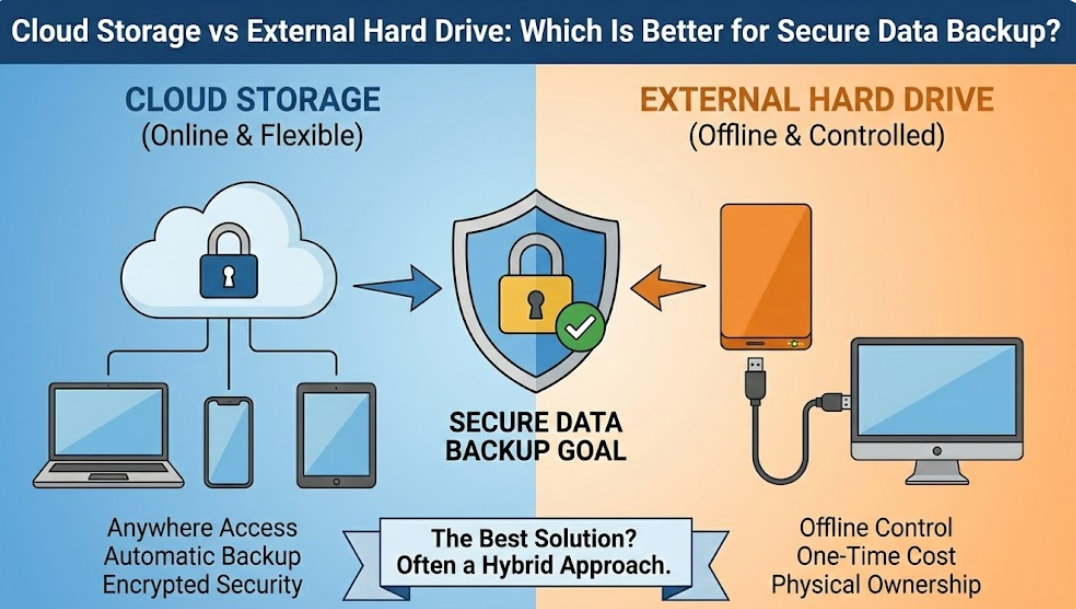
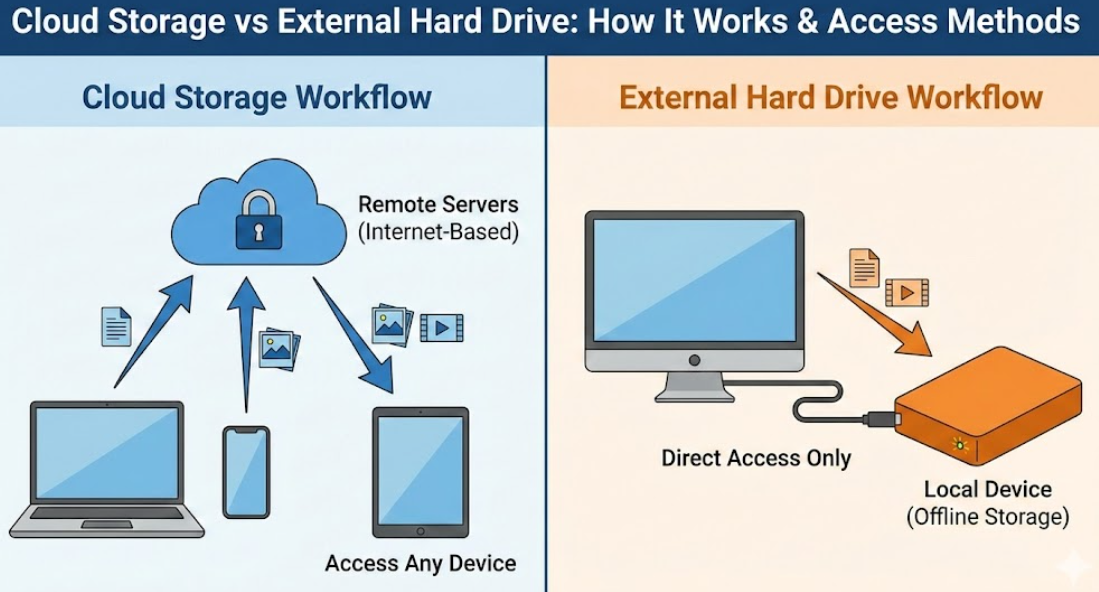
Cloud storage stores your data on remote servers managed by third-party providers. Files can be accessed via the internet using multiple devices, making it a popular choice for online file backup and collaboration.
An external hard drive, on the other hand, is a physical storage device that connects directly to a computer using USB or similar interfaces. It stores data locally and does not rely on an internet connection, making it ideal for offline data storage.
This fundamental difference sets the stage for the broader cloud storage vs hard drive comparison.
Cloud Storage vs External Hard Drive: How They Work
| Feature | Cloud Storage | External Hard Drive |
|---|---|---|
| Storage Type | Online servers | Physical storage devices |
| Access Method | Internet-based | Direct USB connection |
| Accessibility | Any device, anywhere | Limited to connected device |
| Maintenance | Provider-managed | User-managed |
| Scalability | Easy to expand | Limited by capacity |
This comparison shows why Cloud Storage vs External Hard Drive is not a one-size-fits-all decision.
Cloud Storage Pros and Cons
Advantages of Cloud Storage
Cloud platforms are designed for convenience and flexibility. Some of the most notable cloud storage pros and cons start with accessibility.
- Excellent data accessibility from multiple devices
- Seamless file syncing across platforms
- Supports remote data access for teams and businesses
- Automatic backups improve storage reliability
- Strong data security and privacy through encryption
- Highly flexible storage scalability
Disadvantages of Cloud Storage
Despite its benefits, cloud storage has limitations.
- High internet dependency for uploads and downloads
- Ongoing cost of cloud storage through subscriptions
- Limited control over physical data location
- Performance depends on the internet speed
External Hard Drive Pros and Cons
Advantages of External Hard Drives
External drives remain a trusted option for users who prioritize ownership and control.
- Complete offline data storage capability
- One-time purchase with no monthly fees
- High transfer speeds for large files
- Better control over secure file storage
- Long-term reliability with proper care
Disadvantages of External Hard Drives
However, external hard drive pros and cons reveal some drawbacks.
- Risk of physical damage or theft
- Limited remote data access
- No automatic online file backup
- Finite hard drive lifespan
- Manual management of backups
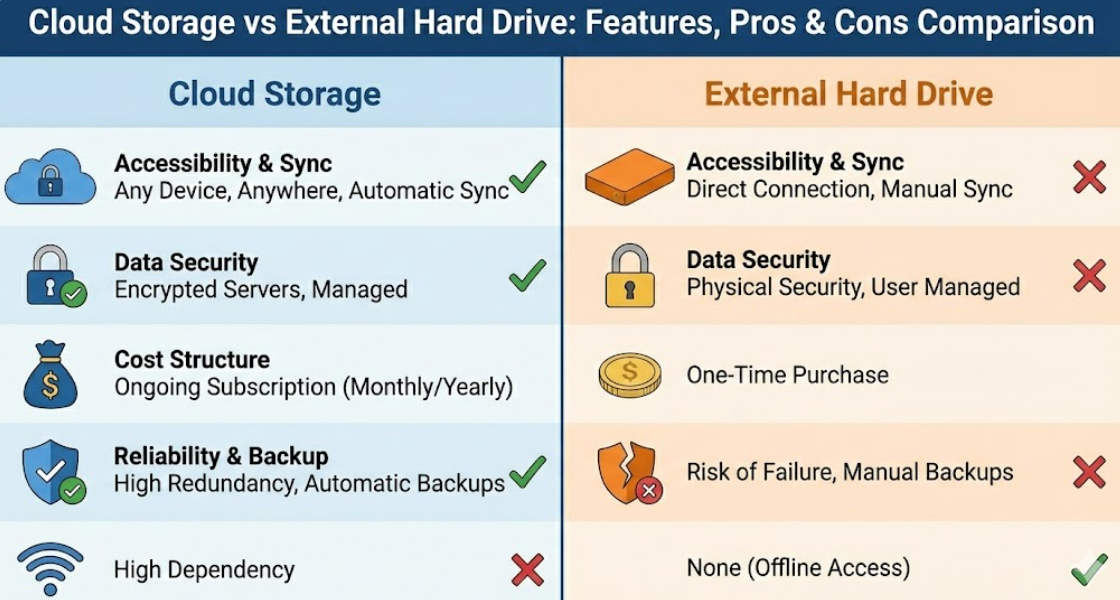
Cloud Storage vs External Hard Drive Comparison Table
| Comparison Factor | Cloud Storage | External Hard Drive |
|---|---|---|
| Accessibility | Anywhere with internet | Local access only |
| Backup Type | Automatic online file backup | Manual backups |
| Security | Encrypted servers | Physical security needed |
| Cost Structure | Monthly/annual plans | One-time purchase |
| Scalability | Easily expandable | Fixed capacity |
This cloud storage vs hard drive comparison clearly shows how each solution fits different user needs.
Data Security and Privacy: Which Is Safer?
When comparing Cloud Storage vs External Hard Drive, security is often the deciding factor.
Cloud providers use encryption, authentication protocols, and redundancy to ensure strong data security and privacy. However, storing files online means trusting a third party.
External hard drives offer full ownership of data, but secure file storage depends entirely on how well the device is protected. Loss, theft, or hardware failure can result in permanent data loss without proper data recovery options.
Storage Reliability and Lifespan Considerations
| Factor | Cloud Storage | External Hard Drive |
|---|---|---|
| Hardware Failure | Provider-managed redundancy | User risk |
| Data Loss Risk | Very low | Moderate to high |
| Longevity | Unlimited with subscription | Limited hard drive lifespan |
| Recovery Options | Version history & restore | Requires recovery software |
From a reliability standpoint, external hard drive vs cloud backup shows cloud platforms have an edge in long-term protection.
Cost of Cloud Storage vs External Hard Drive
The cost of cloud storage usually involves monthly or yearly fees, which can add up over time. However, users benefit from automatic backups, security updates, and scalability.
External hard drives require a one-time investment, making them cost-effective for large, static data collections. Yet, replacing failed drives can increase long-term expenses.
When analyzing Cloud Storage vs External Hard Drive, cost depends on how frequently you store, access, and update data.
Internet Dependency and Accessibility
Cloud storage relies heavily on a stable internet connection. Without it, remote data access becomes impossible.
External drives shine in environments with limited connectivity, offering uninterrupted offline data storage and faster local transfers.
This is why many users combine both as part of hybrid data backup solutions.
Is Cloud Storage Better Than External Hard Drive?
So, is cloud storage better than external hard drive? The answer depends on usage.
Cloud storage is ideal for:
- Businesses and remote teams
- Frequent file access
- Automated backups
- High storage scalability
External hard drives work best for:
- Long-term archiving
- Large media files
- Privacy-focused users
- Internet-free environments
For most users, the smartest approach is combining both for maximum storage reliability.
Best Data Backup Solution: Hybrid Storage Strategy
Using cloud storage for online file backup and an external drive for offline data storage offers the best of both worlds. This hybrid method enhances data recovery options, improves accessibility, and ensures protection against both cyber threats and physical damage.
Final Verdict on Cloud Storage vs External Hard Drive
When deciding between Cloud Storage vs External Hard Drive, there is no absolute winner. Cloud storage excels in convenience, accessibility, and scalability, while external hard drives provide control, affordability, and offline reliability.
Choosing the right solution depends on your data size, budget, security needs, and internet availability. For optimal results, combining both methods creates the most secure and future-proof storage strategy.
Frequently Asked Questions (FAQ)
1. Cloud storage vs external hard drive which is better for backup?
Cloud storage is better for automatic backups, while external drives are ideal for manual offline backups.
2. Is cloud storage safer than an external hard drive?
Cloud platforms offer advanced encryption, but external drives provide full ownership and control.
3. Can I use both cloud storage and external hard drives together?
Yes, combining both creates one of the most reliable data backup solutions.
4. Which is more cost-effective long term?
External drives are cheaper upfront, but cloud storage offers ongoing features and scalability.