Difference Between AI Chatbot And Virtual Assistant. Artificial intelligence has transformed how businesses communicate with customers. From automated customer support to voice-controlled digital helpers, AI tools are everywhere. But many people still confuse two popular technologies: chatbots and virtual assistants.
Understanding the Difference Between AI Chatbot And Virtual Assistant is important for businesses, developers, and even everyday users. Both tools rely on conversational AI technology, but they serve different purposes and operate at different levels of intelligence.
For example, a chatbot on a website may answer basic questions instantly, while a virtual assistant can manage schedules, control smart devices, and perform complex tasks. These solutions are part of a broader ecosystem of AI automation tools, digital assistant technology, and modern AI powered business communication systems.
In this guide, we will explore the real AI chatbot vs virtual assistant comparison, including their features, technologies, benefits, and ideal use cases.
What is an AI Chatbot?
An AI chatbot is a software program designed to simulate conversations with users through text or sometimes voice. These bots typically appear on websites, apps, and messaging platforms.
Most AI powered chatbots are built using natural language processing chatbots technology, which helps them understand user queries and respond automatically.
Businesses often use chatbots for customer support, marketing, and automation tasks. For instance, if you visit an e-commerce website and a small chat window pops up asking, “How can I help you?”, that’s usually a chatbot for websites.
These bots work particularly well for repetitive tasks such as:
- Answering FAQs
- Order tracking
- Appointment booking
- Customer support requests
In fact, many companies rely on an AI customer support chatbot to reduce workload on human support agents.
Common Capabilities of AI Chatbots
| Feature | Description | Example Use |
|---|---|---|
| Instant responses | Replies to common questions automatically | Website support |
| Automated workflows | Uses chatbot automation tools to perform actions | Booking appointments |
| Text-based interaction | Primarily communicates via chat interface | Messaging apps |
| Integration support | Connects with CRM and business systems | Customer service automation |
Because of their speed and efficiency, chatbots have become essential components of smart customer service solutions and conversational AI platforms used by modern businesses.
What is a Virtual Assistant?
A virtual assistant is a more advanced AI system capable of performing tasks, understanding voice commands, and interacting across multiple platforms.
Unlike basic chatbots, intelligent virtual assistants can learn from user behavior and perform complex operations.
Popular examples include systems powered by voice assistant technology, which allow users to control devices, search the internet, or manage schedules using voice commands.
These assistants rely heavily on machine learning virtual assistant technology to continuously improve performance.
For example, a virtual assistant can:
- Set reminders
- Send messages
- Control smart home devices
- Search information online
- Manage daily schedules
All of this happens through sophisticated digital assistant technology that combines AI, voice recognition, and cloud computing.
Key Capabilities of Virtual Assistants
| Feature | Description | Example |
|---|---|---|
| Voice interaction | Uses voice assistant technology for commands | Smart speakers |
| Task automation | Handles multiple complex tasks | Scheduling meetings |
| Learning ability | Uses AI and machine learning | Personalized responses |
| Device integration | Works across multiple devices | Smart homes |
These systems are part of modern AI automation tools designed to simplify everyday tasks and improve productivity.
Difference Between AI Chatbot And Virtual Assistant
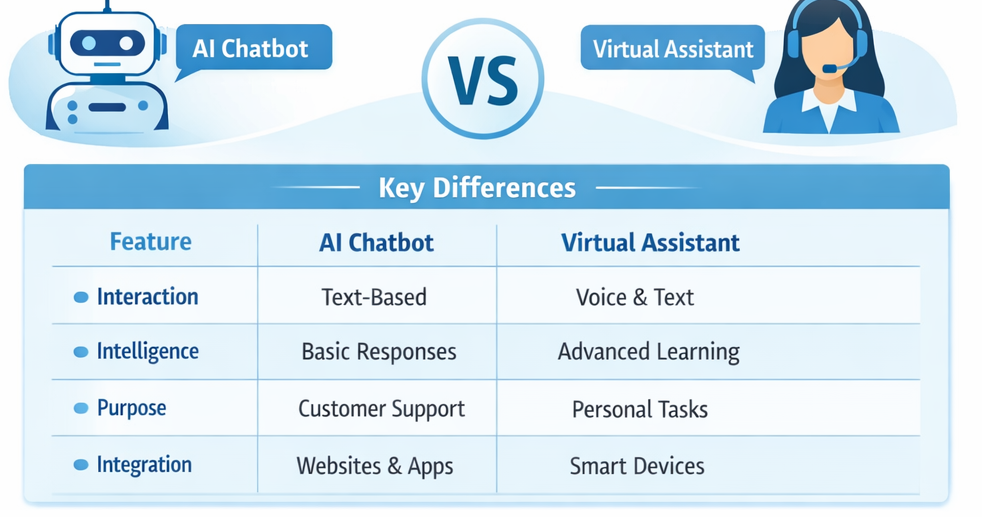
Now let’s break down the Difference Between AI Chatbot And Virtual Assistant more clearly.
While both technologies rely on conversational AI technology, they differ in complexity, functionality, and use cases.
| Feature | AI Chatbot | Virtual Assistant |
|---|---|---|
| Interaction type | Mostly text-based | Voice and text |
| Intelligence level | Limited responses | Advanced AI learning |
| Purpose | Customer service automation | Personal assistance |
| Integration | Website or messaging apps | Multiple devices and systems |
| Learning ability | Limited learning | Uses machine learning |
This AI chatbot vs virtual assistant comparison highlights how chatbots are usually task-specific tools, while virtual assistants operate as full digital helpers.
Chatbot vs Virtual Assistant Differences in Technology
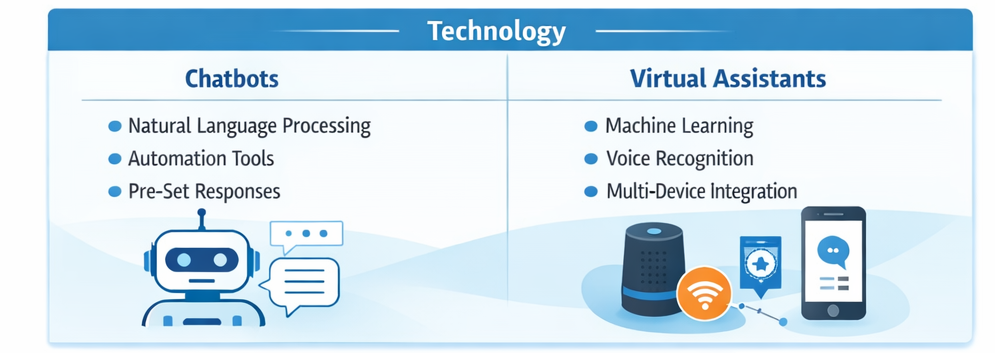
To truly understand the chatbot vs virtual assistant differences, we must look at the underlying technologies.
Chatbot Technology
Chatbots rely mainly on:
- Natural language processing chatbots
- Pre-programmed responses
- Decision trees
- AI conversational bots
These bots are typically part of AI customer service automation strategies used by businesses.
Virtual Assistant Technology
Virtual assistants, on the other hand, rely on:
- Machine learning virtual assistant algorithms
- Voice assistant technology
- Cloud AI systems
- Advanced conversational AI platforms
Because of this, virtual assistants behave more like intelligent digital companions rather than simple automation tools.
Business Use Cases: Chatbots vs Virtual Assistants
Both technologies offer unique benefits depending on the business need.
| Business Need | Best Solution | Why |
|---|---|---|
| Website support | AI customer support chatbot | Handles large volume queries |
| Online sales automation | AI powered chatbots | Guides users through purchases |
| Personal productivity | intelligent virtual assistants | Manages schedules and tasks |
| Smart home integration | Virtual assistant | Works with voice commands |
Companies implementing AI powered business communication often combine both technologies to create seamless user experiences.
For example, a business may use:
- A chatbot for websites for customer queries
- A machine learning virtual assistant for internal productivity tools
Together they create more efficient smart customer service solutions.
Chatbot vs Voice Assistant Comparison
Another interesting perspective is the chatbot vs voice assistant comparison.
Voice assistants are essentially a subset of virtual assistants but focus heavily on spoken interaction.
Chatbots are typically text-based, whereas voice assistants depend on advanced voice assistant technology.
Think about it like this:
- Chatbots = messaging conversations
- Virtual assistants = full digital helper systems
Both technologies belong to the growing world of AI conversational bots and conversational AI technology, which continues to evolve rapidly.
When Should Businesses Use Chatbots?
Chatbots are ideal when businesses need:
- Fast responses to customer questions
- Automated support systems
- 24/7 website engagement
- Reduced support costs
Many companies rely on AI customer service automation because it dramatically improves response time and customer satisfaction.
A well-designed AI customer support chatbot can answer thousands of queries simultaneously without human intervention.
When Should Businesses Use Virtual Assistants?
Virtual assistants are better suited for:
- Personal productivity tools
- Smart home ecosystems
- Enterprise workflow automation
- Voice-controlled systems
These assistants are becoming a key part of digital assistant technology used in both consumer and enterprise environments.
Organizations using AI automation tools often integrate virtual assistants to streamline operations and improve efficiency.
Future of Chatbots and Virtual Assistants
The future of Difference Between AI Chatbot And Virtual Assistant will become even more interesting as AI continues to evolve.
Emerging trends include:
- More advanced AI conversational bots
- Smarter AI powered chatbots
- Fully integrated virtual assistant software
- AI-driven smart customer service solutions
Eventually, the line between chatbots and virtual assistants may blur as conversational AI platforms grow more powerful.
Still, the fundamental AI chatbot vs virtual assistant distinction will likely remain based on complexity and purpose.
Conclusion
Understanding the Difference Between AI Chatbot And Virtual Assistant helps businesses choose the right technology for their needs.
Chatbots are excellent for automating customer support, handling website interactions, and improving response times. They are efficient, affordable, and easy to integrate.
Virtual assistants, however, go far beyond simple conversations. Powered by advanced machine learning virtual assistant systems and voice assistant technology, they can perform complex tasks and act as intelligent digital helpers.
Both technologies are essential parts of modern AI automation tools, digital assistant technology, and AI powered business communication strategies.
Ultimately, the best solution depends on your goal. Need automated customer support? Choose a chatbot. Need a digital assistant capable of managing tasks and learning over time? A virtual assistant is the better option.
FAQ
What is the main Difference Between AI Chatbot And Virtual Assistant?
The main difference is complexity. Chatbots focus on automated conversations, while virtual assistants perform broader tasks using AI and machine learning.
Are chatbots part of conversational AI technology?
Yes, chatbots are one of the most common applications of conversational AI technology used in customer service and business automation.
Can a chatbot become a virtual assistant?
In some cases, advanced chatbots can evolve into assistants when integrated with machine learning virtual assistant systems and voice capabilities.
Are AI powered chatbots good for businesses?
Yes, AI powered chatbots improve customer engagement, automate responses, and support AI customer service automation.
What industries use virtual assistant software?
Industries like healthcare, smart home technology, e-commerce, and enterprise software commonly use virtual assistant software.