How to Secure Remote Work Devices. Remote work has transformed how businesses operate. Employees can now work from virtually anywhere, boosting flexibility and productivity. However, this convenience comes with a significant challenge: security. Every laptop, smartphone, and tablet connected to a company network can become a potential entry point for cybercriminals.
Understanding How to Secure Remote Work Devices is no longer optional. Whether you’re a freelancer, business owner, or part of a distributed workforce, protecting devices and sensitive data should be a top priority. Strong Cybersecurity, Endpoint protection, Data privacy, Network security, and Access control measures help organizations reduce risks while supporting modern work environments.
With the rise of artificial intelligence for remote work, digital workflow optimization, automated business processes, and productivity enhancement technology, remote work is becoming more efficient than ever. Yet these innovations also increase the need for robust security practices.
In this guide, we’ll explore practical strategies, tools, and best practices that help secure remote devices and protect valuable business information.
Why Remote Device Security Matters More Than Ever
The modern workplace extends far beyond the office walls. Employees often access company resources from home networks, coffee shops, airports, and coworking spaces.
This creates several security challenges:
- Unsecured Wi-Fi networks
- Phishing attacks
- Device theft
- Malware infections
- Weak passwords
- Unauthorized access
Effective Remote device security ensures that sensitive business information remains protected regardless of where employees work.
Common Threats Facing Remote Workers
| Threat Type | Risk Level | Potential Impact |
|---|---|---|
| Phishing Emails | High | Credential theft |
| Public Wi-Fi Attacks | High | Data interception |
| Malware & Ransomware | High | Data loss |
| Weak Passwords | Medium | Account compromise |
| Device Theft | Medium | Unauthorized access |
Organizations that ignore Work-from-home cybersecurity often face expensive data breaches, compliance violations, and operational disruptions.
How to Secure Remote Work Devices with Strong Endpoint Protection
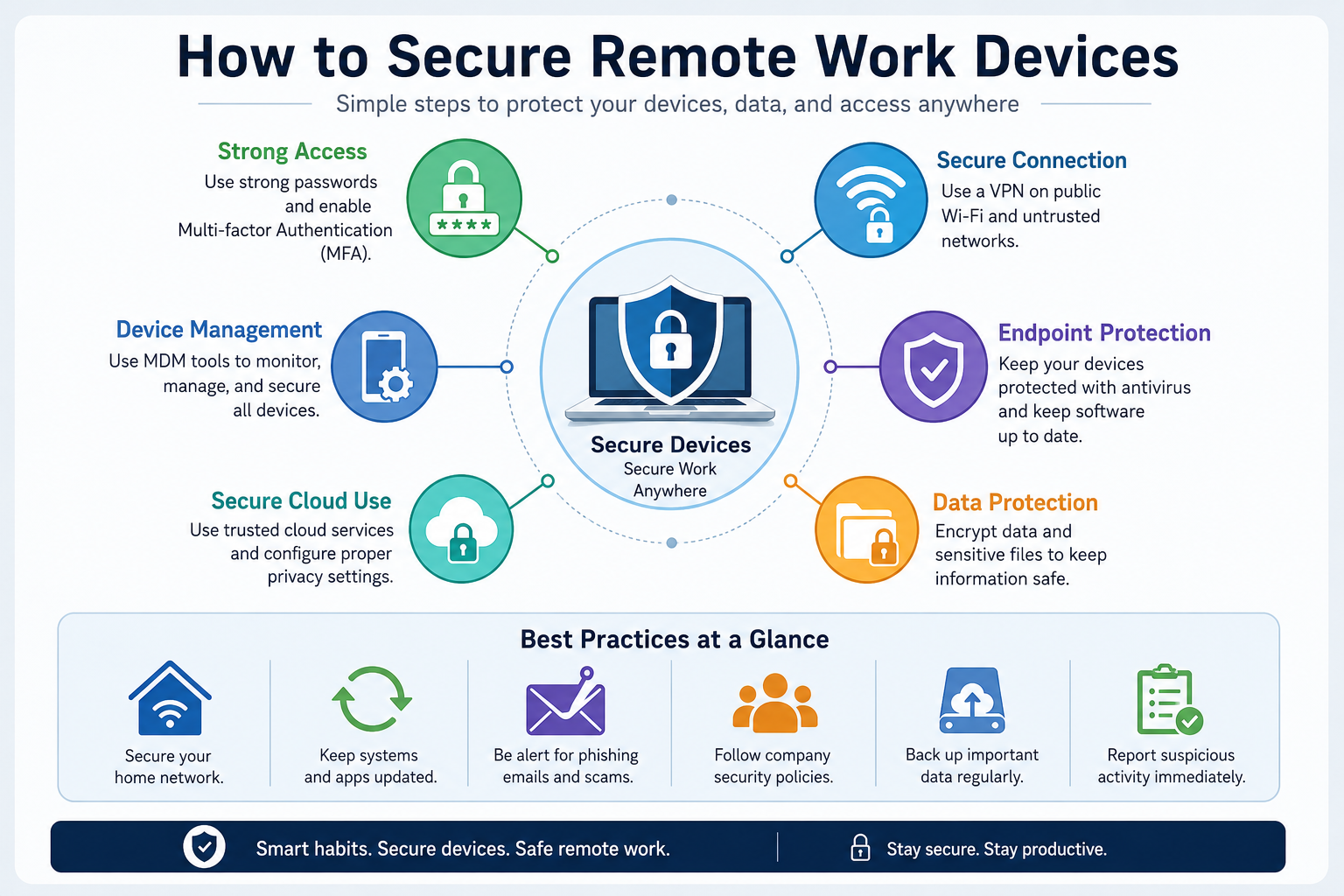
One of the most effective answers to How to Secure Remote Work Devices is implementing comprehensive Endpoint security for remote workers.
Every remote device should have:
- Antivirus software
- Anti-malware protection
- Firewall protection
- Automatic updates
- Threat monitoring tools
Think of endpoint security as a digital security guard constantly monitoring devices for suspicious behavior.
Essential Endpoint Protection Features
| Security Feature | Purpose |
|---|---|
| Antivirus Software | Detects malicious programs |
| Endpoint Detection & Response | Identifies advanced threats |
| Firewall Protection | Blocks unauthorized traffic |
| Patch Management | Fixes vulnerabilities |
| Threat Intelligence | Detects emerging risks |
Strong Endpoint protection significantly reduces the chances of successful cyberattacks.
How to Secure Remote Work Devices Through Secure Remote Access
Employees frequently need access to company files and applications from outside the office.
Providing Secure remote access is critical because unrestricted connections expose business systems to attackers.
Best practices include:
- Restricting access based on user roles
- Monitoring login attempts
- Using encrypted connections
- Applying least-privilege principles
Organizations should also implement proper Access control mechanisms to ensure employees can only access resources relevant to their responsibilities.
A secure access strategy forms the foundation of effective Remote workforce protection.
Use VPN for Remote Employees to Protect Network Traffic
Public networks are convenient but risky.
One simple yet highly effective solution is using a VPN for remote employees.
A VPN creates an encrypted tunnel between a device and the company network, making it extremely difficult for attackers to intercept data.
VPN Benefits for Remote Workers
| Benefit | Security Advantage |
|---|---|
| Encrypted Connection | Protects sensitive data |
| Secure Public Wi-Fi Usage | Prevents eavesdropping |
| IP Address Protection | Improves privacy |
| Secure Business Access | Reduces unauthorized access |
For organizations prioritizing Network security for home offices, VPN deployment should be mandatory rather than optional.
Multi-Factor Authentication (MFA): The First Line of Defense
Passwords alone are no longer sufficient.
Implementing Multi-factor authentication (MFA) dramatically reduces account compromise risks.
Even if attackers steal a password, they still need an additional verification method such as:
- Authentication apps
- Hardware security keys
- SMS verification
- Biometric authentication
Many security professionals consider MFA one of the most cost-effective cybersecurity investments available today.
When discussing How to Secure Remote Work Devices, MFA consistently ranks among the most impactful security measures.
Remote Work Data Protection Through Encryption
Data is often more valuable than the devices themselves.
This is why Remote work data protection requires strong encryption practices.
Businesses should encrypt:
- Hard drives
- Cloud storage
- Email communications
- Shared documents
- Backup systems
Data encryption for remote devices ensures that even if a laptop is lost or stolen, sensitive information remains unreadable.
Encryption plays a major role in improving overall Data privacy and regulatory compliance.
Mobile Device Management (MDM) for Centralized Security
Many employees work using smartphones and tablets.
Managing these devices manually quickly becomes impossible.
This is where Mobile device management (MDM) solutions become valuable.
MDM platforms allow IT teams to:
- Enforce security policies
- Deploy software updates
- Monitor device health
- Remotely wipe lost devices
- Control app installations
Organizations using MDM typically maintain stronger security standards across distributed teams.
Cloud Security for Remote Workers
Most remote teams rely heavily on cloud applications.
While cloud platforms offer flexibility, they also introduce unique security concerns.
Effective Cloud security for remote workers includes:
- Secure file-sharing policies
- User permission management
- Activity monitoring
- Data backup procedures
- Cloud access restrictions
Businesses should regularly audit cloud environments to identify unnecessary permissions and dormant accounts.
This proactive approach improves both Cybersecurity for remote teams and operational efficiency.
Adopt a Zero Trust Security Model
Traditional security assumed that users inside a company network could be trusted.
Modern security doesn’t work that way.
The Zero Trust security model follows a simple principle:
Never trust. Always verify.
Under Zero Trust:
- Every login is verified
- Every device is checked
- Every access request is validated
This approach significantly reduces insider threats and limits attacker movement after a breach.
Many experts view Zero Trust as the future of Remote workforce protection.
How to Secure Remote Work Devices Through Employee Training
Technology alone cannot solve security problems.
Human error remains one of the leading causes of breaches.
Employees should receive training on:
- Recognizing phishing emails
- Creating strong passwords
- Reporting suspicious activity
- Safe browsing habits
- Secure document sharing
I’ve seen organizations invest thousands in security software while overlooking training. Surprisingly, a well-trained employee often prevents more attacks than expensive security tools.
Continuous education strengthens overall Cybersecurity readiness.
Comparison of Basic vs Advanced Remote Security Measures
| Security Area | Basic Protection | Advanced Protection |
|---|---|---|
| Authentication | Passwords | MFA + Biometrics |
| Access Control | Manual Permissions | Zero Trust Access |
| Device Security | Antivirus | Full Endpoint Protection |
| Network Security | Standard Router | VPN + Monitoring |
| Data Protection | Basic Backup | Encryption + Backup |
As businesses adopt freelancer efficiency solutions, artificial intelligence for remote work, and automated business processes, advanced security measures become increasingly important.
Best Practices Checklist for Remote Device Security
If you’re wondering where to start, focus on these essentials:
✔ Enable Multi-factor authentication (MFA)
✔ Deploy VPN for remote employees
✔ Implement Mobile device management (MDM)
✔ Use Data encryption for remote devices
✔ Strengthen Secure remote desktop access controls
✔ Apply the Zero Trust security model
✔ Improve Cloud security for remote workers
✔ Maintain strong Endpoint security for remote workers
✔ Regularly update software and operating systems
✔ Conduct cybersecurity awareness training
Following these practices creates a layered defense strategy that significantly improves organizational security.
Conclusion
Learning How to Secure Remote Work Devices is essential in today’s digital workplace. As organizations embrace remote work, they must prioritize Remote device security, Work-from-home cybersecurity, and Remote work data protection to safeguard sensitive information.
A combination of Secure remote access, VPN for remote employees, Multi-factor authentication (MFA), Mobile device management (MDM), and the Zero Trust security model provides a strong security foundation. These measures not only improve Cybersecurity but also strengthen Endpoint protection, Data privacy, Network security, and Access control across the organization.
As businesses continue leveraging artificial intelligence for remote work, digital workflow optimization, freelancer efficiency solutions, and productivity enhancement technology, maintaining robust security practices will remain critical for long-term success.
FAQ
1. What is the most important step in securing remote work devices?
Implementing Multi-factor authentication (MFA) is one of the most effective ways to prevent unauthorized access.
2. Why should remote employees use a VPN?
A VPN encrypts internet traffic, protecting sensitive business data from interception on public or home networks.
3. What is endpoint security for remote workers?
It refers to security tools and policies that protect laptops, desktops, smartphones, and other devices from cyber threats.
4. How does the Zero Trust security model improve security?
It continuously verifies users and devices before granting access, reducing the risk of unauthorized activity.
5. Is Mobile Device Management (MDM) necessary for small businesses?
Yes. MDM helps businesses manage, secure, and monitor remote devices efficiently, regardless of company size.