AI-Driven Cybersecurity Threat Detection: The Future of Intelligent Digital Defense. Cyber threats are evolving faster than traditional security tools can handle. Static firewalls, rule-based antivirus software, and manual threat analysis are no longer sufficient against sophisticated cyberattacks. This is where AI-driven cybersecurity threat detection becomes a game changer. By leveraging artificial intelligence, organizations can identify threats proactively, respond instantly, and protect digital assets with unprecedented accuracy.
In this article, we explore how AI-Driven Cybersecurity Threat Detection works, its core technologies, real-world applications, and why it is essential for modern enterprises.
What Is AI-Driven Cybersecurity Threat Detection?
AI-Driven Cybersecurity Threat Detection refers to the use of artificial intelligence and machine learning algorithms to identify, analyze, and mitigate cyber threats automatically. Unlike traditional systems, AI-based threat detection systems continuously learn from data patterns, making them highly effective against new and unknown attacks.
This approach enables real-time cyber threat monitoring, allowing security teams to detect suspicious activities before they cause damage.
How AI-Driven Cybersecurity Threat Detection Works
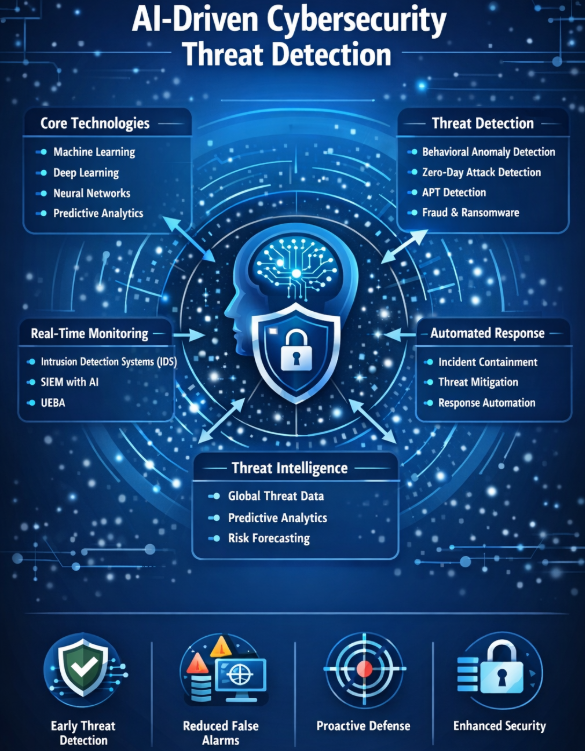
AI-powered security solutions rely on multiple intelligent layers working together. These layers process massive datasets, network logs, and user behaviors to uncover threats that humans may overlook.
Core Technologies Powering AI Security
| Technology | Role in Cybersecurity | Key Benefit |
|---|---|---|
| machine learning in cybersecurity | Learns attack patterns from historical data | Improves detection accuracy over time |
| deep learning for network security | Analyzes complex network traffic | Identifies hidden attack behaviors |
| neural networks for malware detection | Detects malicious code structures | Stops advanced malware |
| predictive cyber threat analytics | Forecasts potential attacks | Prevents breaches before they occur |
These technologies allow AI systems to move from reactive defense to proactive protection.
Behavioral Intelligence and Anomaly Detection
One of the most powerful features of AI security is behavioral anomaly detection. Instead of relying on predefined rules, AI observes how users and systems normally behave.
User and Entity Behavior Analytics (UEBA)
User and entity behavior analytics (UEBA) creates behavioral baselines for employees, devices, and applications. When deviations occur—such as unusual login times or data transfers—alerts are triggered instantly.
| Behavior Signal | AI Action | Security Outcome |
|---|---|---|
| Unusual login location | Flag activity | Prevent account takeover |
| Sudden data downloads | Trigger alert | Stop data exfiltration |
| Privilege misuse | Restrict access | Reduce insider threats |
This approach dramatically reduces false positives while improving detection accuracy.
Real-Time Detection and Automated Response
Modern cyberattacks happen in seconds. AI responds just as fast.
AI-powered intrusion detection systems (IDS)
AI-powered intrusion detection systems (IDS) continuously scan network traffic, identifying malicious patterns in real time. Combined with security information and event management (SIEM) with AI, organizations gain centralized visibility into all security events.
Automated Incident Handling
With automated security incident response, AI can:
- Isolate infected systems
- Block malicious IP addresses
- Revoke compromised credentials
- Notify security teams instantly
This automation significantly reduces response time and limits damage.
Advanced Threat Protection Capabilities
AI excels at identifying threats that traditional tools often miss.
Detecting Sophisticated Attacks
- advanced persistent threat (APT) detection identifies long-term stealthy attacks
- zero-day attack detection using AI recognizes unknown vulnerabilities
- AI-driven fraud and ransomware detection prevents financial and data losses
| Threat Type | Traditional Tools | AI Advantage |
|---|---|---|
| Zero-day attacks | Often undetected | Pattern-based detection |
| APTs | Manual investigation | Continuous monitoring |
| Ransomware | Post-infection response | Pre-execution prevention |
AI’s adaptive learning enables defense against evolving attack techniques.
Threat Intelligence and Predictive Security
Cybersecurity Threat Intelligence Platforms
Cybersecurity threat intelligence platforms powered by AI aggregate global threat data, attack signatures, and vulnerability reports. AI analyzes this data to identify emerging threats across industries.
Predictive Defense Strategy
Using predictive cyber threat analytics, organizations can:
- Anticipate future attack vectors
- Strengthen vulnerable systems
- Improve security posture proactively
This shifts cybersecurity from damage control to risk prevention.
Benefits of AI-Driven Cybersecurity Threat Detection
Implementing AI-Driven Cybersecurity Threat Detection delivers measurable business and security advantages:
- Faster threat identification
- Reduced operational costs
- Fewer false positives
- Improved compliance readiness
- Enhanced data protection
By integrating AI-based threat detection systems, businesses achieve scalable and resilient cybersecurity.
Challenges and Considerations
Despite its benefits, AI security requires careful implementation.
Key Challenges
- High-quality data requirements
- Integration with legacy systems
- AI model transparency
- Skilled personnel availability
However, with proper planning, these challenges are manageable and outweighed by long-term security gains.
The Future of AI in Cybersecurity
As cyber threats grow more complex, AI-Driven Cybersecurity Threat Detection will become the industry standard. Future developments will include:
- Fully autonomous security operations
- Self-healing networks
- Enhanced cross-platform intelligence sharing
Organizations adopting AI today gain a critical competitive advantage tomorrow.
Frequently Asked Questions (FAQ)
1. What makes AI-Driven Cybersecurity Threat Detection better than traditional security?
AI adapts to new threats, analyzes behavior, and detects attacks in real time—capabilities traditional tools lack.
2. Can AI detect zero-day attacks?
Yes, zero-day attack detection using AI relies on anomaly patterns rather than known signatures.
3. Is AI cybersecurity suitable for small businesses?
Absolutely. Cloud-based AI-based threat detection systems are scalable and cost-effective.
4. How does AI reduce false alerts?
By using behavioral anomaly detection and UEBA, AI understands normal activity patterns.
5. Does AI replace human security teams?
No. AI enhances human decision-making by automating detection and response.