Difference Between Encryption And Hashing. Why Understanding Data Security Matter. In today’s digital world, data protection and information security are not optional—they’re essential. Whether you’re logging into a website, sending an email, or making an online payment, your data is constantly at risk. That’s where cryptography basics come into play.
Two of the most important concepts in digital security are encryption and hashing. Many people confuse them—and honestly, that’s understandable. At first glance, both seem to “scramble” data. But the Difference Between Encryption And Hashing goes much deeper.
So, what is actually happening behind the scenes? And more importantly—when should you use each?
Let’s break it down in a simple, practical, and human way.
What is Difference Between Encryption And Hashing?
Before diving deeper, let’s clarify what is Difference Between Encryption And Hashing in the simplest terms:
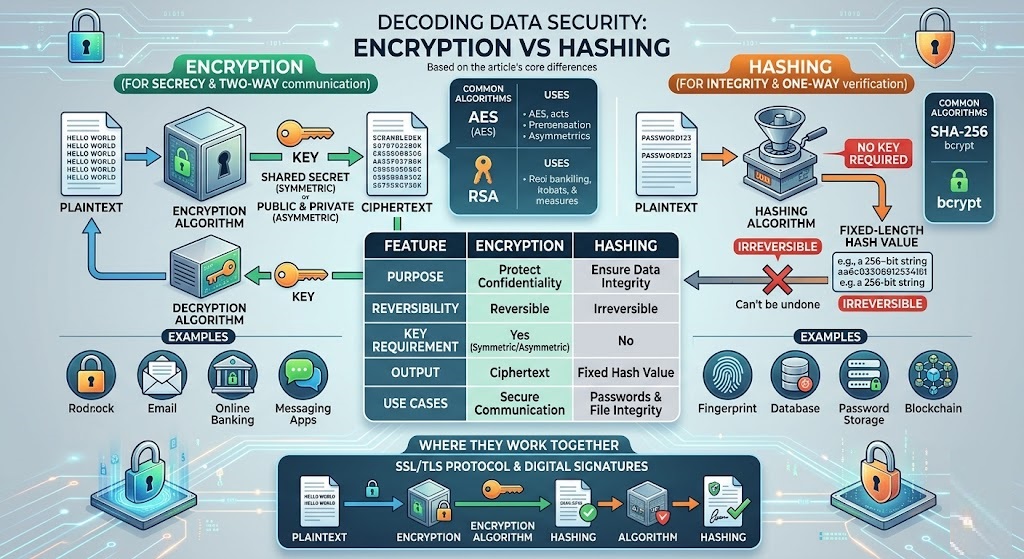
- Encryption converts data into a secret format that can be reversed using a key.
- Hashing converts data into a fixed string that cannot be reversed.
That’s the core idea. But there’s a lot more nuance when you look at real-world use cases like secure authentication and digital security systems.
🔐 Understanding Encryption (With Real Use Cases)
Encryption is all about secrecy. You take readable data (plaintext), apply an algorithm, and turn it into unreadable data (ciphertext).
Only someone with the correct key can unlock it.
Why Encryption Matters
Think about:
- Online banking
- Messaging apps
- Cloud storage
Without data encryption techniques, your sensitive information would be exposed instantly.
Common Types of Encryption
- Symmetric encryption (same key for encryption & decryption)
- Asymmetric encryption (public + private key system)
This is where symmetric vs asymmetric encryption becomes important. For example, HTTPS uses both to ensure secure data transmission.
Encryption Algorithms Examples (Practical View)
Here’s a quick table showing popular encryption methods:
| Algorithm | Type | Use Case | Security Level |
|---|---|---|---|
| AES | Symmetric | File encryption, VPNs | Very High |
| RSA | Asymmetric | Secure key exchange | High |
| DES | Symmetric | Legacy systems | Low |
| ECC | Asymmetric | Mobile security | Very High |
These encryption algorithms examples are widely used in modern cybersecurity encryption methods.
Understanding Hashing (The One-Way Street)
Now here’s where things get interesting.
Hashing is NOT about secrecy—it’s about verification.
When you input data into a hashing algorithm, it produces a fixed-length output. Even a tiny change in input gives a completely different result.
Why Hashing is Important
- Password storage
- File verification
- Blockchain systems
Instead of storing actual passwords, systems use password hashing methods to store hash values.
Hashing Algorithms and Their Use
Here’s a comparison of common hashing algorithms:
| Algorithm | Output Length | Security Level | Common Use |
|---|---|---|---|
| MD5 | 128-bit | Low | Legacy checksums |
| SHA-1 | 160-bit | Weak | Deprecated systems |
| SHA-256 | 256-bit | Very High | Modern security applications |
| bcrypt | Variable | Very High | Secure password storage |
👉 Today, SHA-256 hashing is one of the most trusted methods in cryptographic hash functions.
Difference Between Encryption And Hashing (Detailed Comparison)
Now let’s clearly explain the Difference Between Encryption And Hashing with a structured table.
| Feature | Encryption | Hashing |
|---|---|---|
| Purpose | Protect confidentiality | Ensure data integrity |
| Reversibility | Reversible (with key) | Irreversible |
| Key Requirement | Yes | No |
| Output | Ciphertext | Fixed hash value |
| Speed | Slower | Faster |
| Use Case | Secure communication | Password storage & verification |
This table alone explains most of the encryption vs hashing explained concept—but let’s go deeper.
Encryption vs Hashing Explained with Real-Life Examples
Let’s say you send a message:
- Encryption ensures only the receiver reads it
- Hashing ensures the message wasn’t altered
Simple, right?
Another example:
- Login systems use hashing for secure password storage
- Payment systems use encryption for secure data transmission
This combination forms the backbone of modern data security methods.
MD5 vs SHA Comparison (Why It Matters Today)
A lot of people still ask about MD5 vs SHA comparison. Here’s a clear table:
| Feature | MD5 | SHA-256 |
|---|---|---|
| Security | Weak | Strong |
| Speed | Fast | Moderate |
| Collision Risk | High | Extremely Low |
| Usage | Deprecated | Widely used |
Honestly, using MD5 today is like locking your door with a broken latch. It works—but not really.
Where Encryption and Hashing Work Together
Here’s something many guides miss.
Encryption and hashing are often used together, not separately.
For example:
- Digital signature verification uses hashing + encryption
- SSL/TLS protocols use both for secure communication
- Systems perform a data integrity check using hashes while encrypting data in transit
This layered approach improves overall digital security.
Practical Insight (From Experience)
If you’ve ever built or worked with a login system, you’ll notice something interesting—passwords are never decrypted. They’re hashed.
That’s intentional.
Why? Because even developers shouldn’t see user passwords. That’s the power of hashing.
On the other hand, if you’re storing confidential files, encryption is necessary because you’ll need access later.
So the choice isn’t “which is better?”
It’s “which fits the situation?”
Best Use Cases Summary
- Use encryption for:
- Emails
- File storage
- Secure APIs
- Use hashing for:
- Passwords
- Blockchain
- File verification
This is the real-world Difference Between Encryption And Hashing in action.
FAQ: Difference Between Encryption And Hashing
1. What is the main Difference Between Encryption And Hashing?
Encryption is reversible and used for secrecy, while hashing is irreversible and used for verification.
2. Can hashing be decrypted?
No, hashing cannot be reversed. That’s why it’s used in secure authentication systems.
3. Which is more secure: encryption or hashing?
Both serve different purposes. Encryption protects data, while hashing ensures integrity.
4. Why is SHA-256 better than MD5?
Because SHA-256 hashing is far more secure and resistant to collisions compared to MD5.
5. Do modern systems use both encryption and hashing?
Yes, most modern cybersecurity encryption methods combine both for maximum protection.
Conclusion
Understanding the Difference Between Encryption And Hashing isn’t just for cybersecurity experts—it’s something every developer, blogger, and digital user should know.
Encryption keeps your data secret.
Hashing keeps your data trustworthy.
Together, they form the backbone of modern data protection, information security, and digital security systems.
And honestly, once you understand how they work, you’ll start noticing them everywhere—from login pages to encrypted chats.
If you’re working online in any capacity, mastering these concepts isn’t optional anymore—it’s essential.