How AI Is Changing SEO Strategy. Search engine optimization has changed more in the last few years than it did in the previous decade. Honestly, many marketers are still trying to catch up. The rise of artificial intelligence in digital marketing has completely reshaped how websites rank, how users search, and how businesses create content.
Today, Google is smarter. Search engines no longer depend only on keywords stuffed into articles. Instead, they analyze context, behavior, and intent. That’s exactly where AI steps in. From AI-powered SEO tools to predictive SEO analytics, artificial intelligence is making optimization faster, more accurate, and surprisingly more human-focused.
If you’ve worked on SEO recently, you’ve probably noticed something strange. Old tricks barely work anymore. Thin articles disappear. Random backlinks don’t help much. Search engines now prioritize relevance, experience, and genuine value. This shift represents the real future of search engine optimization.
In this article, we’ll explore How AI Is Changing SEO Strategy, the tools businesses are using, and why modern SEO is becoming deeply connected to machine learning and user behavior.
How AI Is Changing SEO Strategy in Modern Digital Marketing
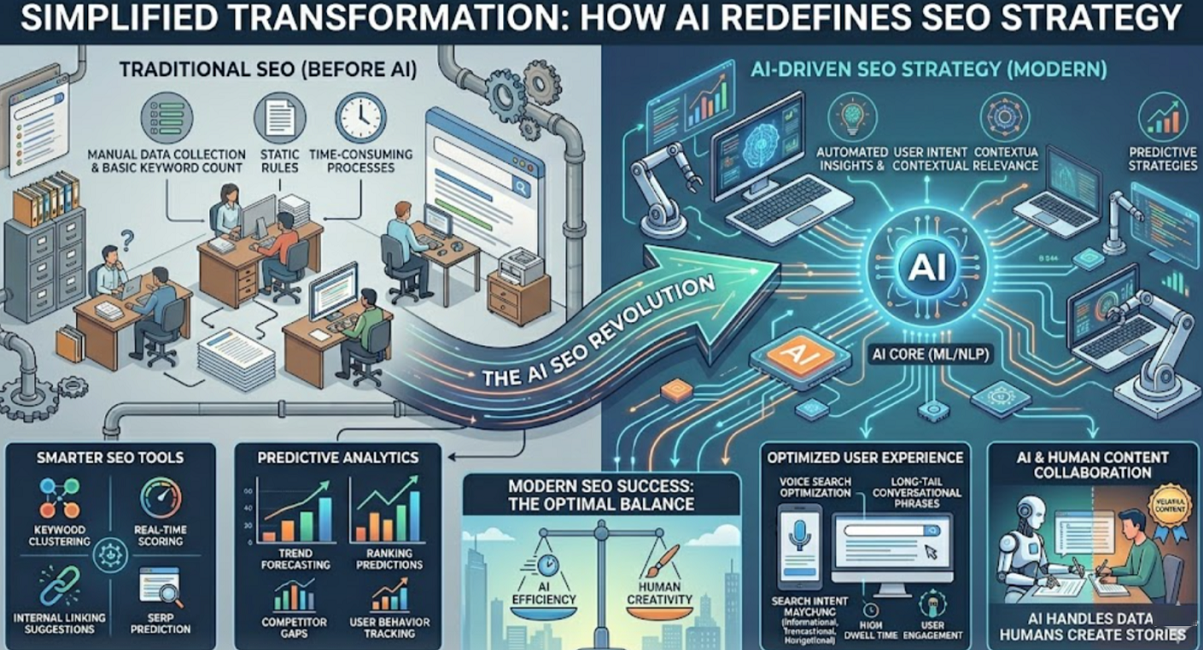
The biggest impact of AI on SEO is automation combined with intelligence. Earlier, SEO professionals spent hours manually analyzing keywords, competitors, and ranking reports. Now AI systems can process huge datasets within seconds.
This change is not just about speed. It’s about smarter decisions.
Modern AI-driven digital marketing platforms can identify trends before they become popular. They can predict which content may rank, which keywords are losing value, and what users are actually searching for.
Traditional SEO vs AI-Driven SEO
| Traditional SEO | AI-Driven SEO |
|---|---|
| Manual keyword analysis | Automated keyword research |
| Static optimization methods | Dynamic real-time optimization |
| Generic content creation | Personalized content experiences |
| Focused mainly on keywords | Focused on intent and context |
| Limited data interpretation | Deep predictive analysis |
Many experts now believe that intelligent search algorithms will eventually dominate the entire ranking ecosystem. And honestly, that prediction already seems true.
The Role of AI-Powered SEO Tools
One of the clearest examples of How AI Is Changing SEO Strategy is the rise of smart optimization platforms. These tools can analyze search trends, competitor gaps, technical errors, and user engagement almost instantly.
Popular SEO automation tools now provide:
- Keyword clustering
- Internal linking suggestions
- Real-time optimization scores
- SERP prediction analysis
- Content readability improvements
- Search intent matching
What makes these tools powerful is their ability to understand patterns. They don’t simply count keywords anymore. Instead, they study semantic relationships and user expectations.
For example, if someone searches “best laptops for students,” Google understands they probably want affordability, battery life, and portability. That’s where natural language processing SEO becomes essential.
Benefits of AI SEO Tools
| AI Feature | SEO Benefit |
|---|---|
| Machine learning analysis | Better ranking predictions |
| NLP processing | Improved semantic relevance |
| Automation workflows | Saves time and resources |
| Predictive analytics | Smarter content planning |
| Behavioral tracking | Better user engagement |
Some marketers worry that AI may replace SEO professionals entirely. Realistically though, AI works best as an assistant rather than a replacement. Human creativity still matters a lot.
Machine Learning in SEO and Search Engine Ranking Factors
Google’s algorithms have become incredibly advanced because of machine learning in SEO. Instead of relying only on backlinks and keywords, search engines now evaluate deeper signals.
Modern search engine ranking factors include:
- User engagement
- Dwell time
- Mobile experience
- Search intent satisfaction
- Content quality
- Expertise and trustworthiness
This shift explains why many older SEO strategies fail today.
A few years ago, writing a long article with repeated keywords could help rankings. Not anymore. Search engines now analyze whether users actually find value in the content.
And honestly, users can tell when an article feels robotic.
That’s why successful websites focus on authenticity, clarity, and usefulness. AI helps identify what audiences want, but humans still need to create relatable experiences.
How AI Is Changing SEO Strategy Through Search Intent
Understanding user search intent is probably the biggest breakthrough AI has brought to SEO.
Search intent usually falls into four categories:
- Informational
- Navigational
- Transactional
- Commercial investigation
AI systems analyze billions of searches to understand these behaviors. This makes content optimization far more accurate.
For instance, someone searching “how to fix laptop overheating” wants a solution, not a sales page. Meanwhile, someone searching “best gaming laptop under $1000” is closer to purchasing.
This is where AI content optimization becomes extremely valuable.
Search Intent Optimization Table
| Search Type | User Goal | AI Optimization Approach |
|---|---|---|
| Informational | Learn something | Educational long-form content |
| Transactional | Buy a product | Product-focused landing pages |
| Navigational | Find a website | Brand optimization |
| Commercial | Compare options | Reviews and comparison guides |
Many SEO professionals now rely heavily on data-driven SEO techniques because guessing intent simply isn’t enough anymore.
AI-Generated Content: Helpful or Risky?
There’s a lot of debate around AI-generated content. Some people love it. Others think it’s damaging content quality online.
The truth sits somewhere in the middle.
AI can definitely help create outlines, improve structure, and speed up drafting. But fully automated content often lacks originality and emotional connection.
Google has repeatedly emphasized that helpful content matters more than how it’s produced. So technically, AI-assisted articles are acceptable if they provide real value.
Still, overusing automation creates predictable writing patterns. Readers notice it quickly.
That’s why strong SEO writers combine AI efficiency with human storytelling. A little personality goes a long way.
The best-performing blogs today often use an AI-based content strategy rather than complete automation.
Voice Search Optimization and Smart Search Behaviour
Another major reason How AI Is Changing SEO Strategy matters is the explosion of voice search.
People no longer search only by typing short phrases. They ask complete questions like:
- “What’s the best budget smartphone this year?”
- “How do I improve WiFi speed at home?”
This shift changed keyword targeting dramatically.
Voice search optimization focuses on:
- Conversational keywords
- Long-tail phrases
- Question-based headings
- Natural sentence structures
AI systems understand spoken language much better thanks to natural language processing SEO improvements.
Honestly, many websites still ignore voice optimization. That creates huge opportunities for businesses willing to adapt early.
Predictive SEO Analytics and Future Rankings
Perhaps the most impressive development is predictive SEO analytics.
Instead of reacting after rankings drop, AI tools can now forecast trends before they happen.
Imagine knowing:
- Which keywords will grow next month
- Which pages may lose traffic
- Which competitors are gaining authority
- What users will search for next season
That’s powerful.
Businesses using predictive insights can create content earlier and rank before competition increases. This approach represents the true future of search engine optimization.
AI Predictive SEO Applications
| Predictive Feature | Business Advantage |
|---|---|
| Trend forecasting | Early ranking opportunities |
| Competitor monitoring | Faster strategy adjustments |
| Traffic prediction | Better campaign planning |
| Content gap analysis | Higher topical authority |
It almost feels unfair sometimes. Companies using AI gain massive efficiency advantages compared to traditional SEO workflows.
Google Algorithm Updates and AI Adaptation
Keeping up with Google algorithm updates has always been frustrating for marketers. Rankings change overnight. Traffic disappears unexpectedly.
AI tools help reduce that uncertainty.
Modern systems track ranking volatility, SERP movement, and content performance continuously. They can identify patterns humans might miss entirely.
More importantly, AI helps websites adapt quickly by recommending:
- Content improvements
- Semantic keyword additions
- Technical fixes
- Internal link updates
- Readability changes
This adaptability is becoming essential in modern SEO.
Content Personalization and User Experience
Search engines increasingly prioritize personalized experiences. Users expect content tailored to their needs, location, and interests.
AI makes content personalization much easier.
For example:
- Ecommerce stores recommend relevant products
- Blogs show related articles dynamically
- Websites adjust CTAs based on behavior
- Search results become more personalized
This creates better engagement, which indirectly improves rankings.
At the end of the day, SEO is no longer just about algorithms. It’s about satisfying real humans.
And ironically, AI is helping marketers become more human-focused.
Conclusion
There’s no denying that How AI Is Changing SEO Strategy has become one of the most important topics in digital marketing today. AI is transforming keyword research, optimization, analytics, personalization, and even content creation itself.
From AI-powered SEO tools to smart search optimization, businesses now rely heavily on automation and machine intelligence to stay competitive. At the same time, human creativity still plays a crucial role. AI can analyze data, but it cannot fully replace authentic storytelling or real-world experience.
The smartest approach moving forward is balance.
Use AI for efficiency. Use human insight for connection.
That combination is what will define the next generation of SEO success.
As artificial intelligence in digital marketing continues evolving, marketers who adapt early will likely dominate rankings, traffic, and audience trust in the years ahead.
FAQ
Is AI replacing SEO experts?
No. AI improves efficiency and data analysis, but human creativity, strategy, and audience understanding are still essential.
Are AI-generated articles good for SEO?
They can be helpful if edited properly and provide valuable information. Low-quality automated content may still perform poorly.
What are the best uses of AI in SEO?
The most effective uses include automated keyword research, predictive analytics, technical SEO audits, and content optimization.
Why is search intent important in AI SEO?
AI systems analyze user search intent to deliver more accurate results. Matching intent improves engagement and rankings.
How does voice search affect SEO strategy?
Voice search optimization requires conversational language, long-tail keywords, and natural sentence structures for better visibility.