How to Use AI for Competitor Analysis. Understanding what your competitors are doing is one of the most important parts of building a successful website or online business. However, manually checking competitor websites, analyzing keywords, comparing backlinks, and tracking search engine rankings can take hours. Even then, you might miss valuable opportunities.
This is where artificial intelligence makes a difference.
Learning How to Use AI for Competitor Analysis can help you discover keyword opportunities, identify content gaps, understand competitor SEO strategies, and make smarter marketing decisions. Instead of spending hours collecting information, you can use AI tools to organize research and highlight areas that deserve your attention.
Whether you run a technology blog, an eCommerce store, or a digital marketing website, AI can make competitor research faster and more practical. Let’s explore how to use it effectively.
What Is AI-Powered Competitor Analysis?
AI-powered competitor analysis is the process of using artificial intelligence and data analysis tools to evaluate competing websites, their content, keyword strategies, backlinks, traffic patterns, and overall market positioning.
Traditional competitor research often requires checking multiple platforms separately. In contrast, AI-Powered Competitor Analysis helps organize information, identify patterns, and turn collected data into useful recommendations.
For example, you can use AI to investigate why another technology website ranks higher for a particular keyword. It can help you examine content structure, search intent, keyword coverage, and potential content gaps.
However, AI does not automatically know every competitor’s private analytics. Reliable findings still depend on accurate data from SEO platforms and publicly available information.
How to Use AI for Competitor Analysis Step by Step
You don’t need advanced technical knowledge to begin. Follow these steps to build a practical competitor research process.
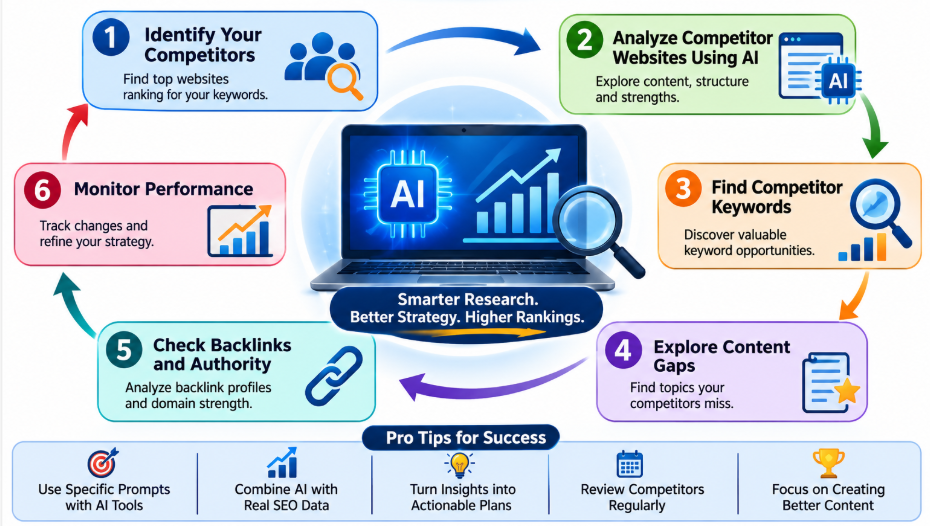
Step 1: Identify Your Main Competitors
Start by identifying websites that compete for the same audience and search queries. These might not always be businesses selling identical products.
For example, a laptop repair blog may compete with technology tutorials, troubleshooting websites, and hardware information platforms.
Use search engines to find websites ranking for your important keywords. You can also use AI Tools for Competitive Intelligence to organize competitor information and identify relevant market segments.
Create a shortlist of three to five websites. Focus on competitors with similar audiences rather than choosing large websites simply because they are popular.
Step 2: Analyze Competitor Websites Using AI
Once you have identified competitors, examine their website structure, published content, internal linking, and user experience.
Learning How to Analyze Competitor Websites Using AI helps you identify what makes competing pages useful and where your own website can improve.
You can use AI Website Analysis Tools alongside platforms such as ChatGPT, Semrush, and Ahrefs to organize your findings.
Look for:
- Topics competitors publish frequently.
- Articles receiving strong organic visibility.
- Missing information in their existing content.
- Internal linking opportunities.
- Content formats that satisfy search intent.
- Technical issues affecting usability.
The objective is not to copy another website. Instead, understand its strengths and create something more helpful.
Step 3: Find Competitor Keywords Using AI
Keyword research is one of the most valuable applications of AI in SEO.
With Competitor Keyword Analysis Using AI, you can organize keyword lists, identify related search terms, and discover topics that competitors may be overlooking.
For example, suppose a competitor publishes an article about fixing laptop overheating. You could explore related searches such as:
- Laptop overheating while gaming.
- How to reduce CPU temperature.
- Laptop cooling pad effectiveness.
- How to clean laptop cooling fans.
- High CPU temperature after Windows update.
To understand How to Find Competitor Keywords Using AI, combine keyword data from SEO platforms with AI-assisted analysis. Check search volume, keyword difficulty, search intent, and ranking competition before selecting a topic.
Step 4: Discover Content Gaps
A content gap exists when your competitors cover useful topics that your website has not addressed adequately.
AI Content Gap Analysis helps identify missing subtopics, unanswered questions, and related keyword opportunities.
For instance, if competing laptop repair websites explain BIOS updates but rarely discuss BIOS recovery after a failed update, that could represent an opportunity for a detailed troubleshooting guide.
Compare your content against competing pages and ask:
- Which important questions have they answered?
- What information is missing?
- Are their instructions outdated?
- Can you provide clearer explanations or original examples?
- Which related topics deserve separate articles?
This approach can improve content performance without publishing unnecessary articles.
Step 5: Examine Competitor Backlinks
Backlinks remain an important part of understanding a website’s authority and link-building strategy.
Competitor Backlink Analysis Using AI can help organize backlink reports, classify referring websites, and identify patterns worth investigating.
Tools such as Ahrefs and Semrush provide backlink information, while AI can help summarize large reports and group potential outreach opportunities.
Pay attention to relevant technology blogs, educational resources, industry publications, and websites linking to multiple competitors.
A useful backlink is not simply a link from a high-authority domain. Relevance, editorial quality, and the context of the link matter too.
Step 6: Monitor Competitor Performance
Competitor research should not be a one-time activity. Search rankings, content strategies, and market trends change regularly.
AI Competitor Monitoring Tools can help organize recurring reports and highlight changes worth investigating.
Track these important metrics:
- Organic search performance.
- Search engine rankings.
- Estimated competitor website traffic.
- New and lost backlinks.
- Published content.
- Keyword visibility.
- SERP changes.
This creates a clearer picture of your competitors’ progress and helps you respond to meaningful changes.
Best AI Competitor Analysis Tools Compared
Different platforms serve different purposes. Some specialize in SEO data, while others help with research, summarization, and strategic planning.
| Tool | Main Purpose | Best Use |
|---|---|---|
| ChatGPT | AI research and analysis | Content comparisons and research prompts |
| Semrush | SEO competitor research | Keyword gaps and organic visibility |
| Ahrefs | Backlink and keyword analysis | Link research and content opportunities |
| Similarweb | Traffic intelligence | Audience and traffic estimates |
| Google Gemini | AI research assistance | Research organization and comparisons |
These are useful AI Competitor Research Tools, but they should not be treated as interchangeable. SEO platforms provide measurable datasets, whereas general AI assistants are better at interpreting information and suggesting next steps.
Three Practical Ways to Get Better Results From AI
1. Use Specific Prompts
A vague prompt produces generic recommendations. Give AI clear instructions, relevant website information, and a defined objective.
Try this prompt:
“Analyze the following three competitor websites in the technology niche. Compare their content topics, keyword coverage, article structure, and potential content gaps. Suggest 10 relevant article opportunities for my website. Do not invent traffic or ranking statistics.”
This is a practical example of ChatGPT for Competitor Analysis.
2. Combine AI With Real SEO Data
Do not rely on AI-generated estimates for search volume, keyword difficulty, or website traffic.
Use established Competitor Traffic Analysis Tools and keyword research platforms to collect measurable data. Then use AI to interpret the reports, identify patterns, and prioritize opportunities.
3. Turn Research Into an Action Plan
Research is only valuable when you use it.
After completing your AI SEO Competitor Analysis, create a prioritized content plan. Focus on relevant keywords, weak competing content, unanswered questions, and topics that match your audience’s needs.
This process supports better competitive benchmarking and more sustainable organic traffic growth.
How To Disable Secure Boot For Legacy Device
Common AI Competitor Analysis Problems and Solutions
AI can make research easier, but inaccurate information and poorly defined instructions can lead to disappointing results.
| Common Problem | Possible Reason | Recommended Solution |
|---|---|---|
| Incorrect keyword data | AI-generated estimates | Verify figures using SEO tools |
| Generic recommendations | Vague prompts | Provide competitor URLs and specific goals |
| Missing competitors | Limited research scope | Check additional SERP results |
| Inaccurate traffic estimates | Third-party estimation limitations | Compare multiple data sources |
| Duplicate content ideas | Insufficient gap analysis | Compare actual page coverage |
| Outdated recommendations | Old datasets | Refresh research regularly |
Important warning: Never publish competitor traffic figures, backlink statistics, or ranking claims without checking their original sources. AI can misunderstand reports or present estimates as verified facts.
How to Compare Competitor SEO Strategies Using AI
A useful competitor comparison should evaluate more than keyword rankings.
Consider the following factors:
- Content quality and topical coverage.
- Organic search visibility.
- Keyword opportunities.
- Backlink profile.
- Internal linking structure.
- Search intent analysis.
- Technical SEO performance.
- User experience and content freshness.
How to Compare Competitor SEO Strategies becomes much easier when you place this information into a consistent comparison sheet.
For advanced users, combining these findings with AI Market Research Tools, AI Marketing Intelligence Tools, and Automated Competitor Analysis workflows can reveal changes in market positioning.
You can also apply AI-Powered SEO Analysis to investigate how competitors appear in traditional search results and AI-generated answers. This supports a broader Generative Engine Optimization (GEO) strategy.
Best Free AI Video Editing Tools
Frequently Asked Questions
1. Can ChatGPT analyze competitor websites?
Yes. ChatGPT can help compare website content, organize competitor research, identify potential content gaps, and suggest keyword opportunities. Provide relevant URLs or source data and verify important findings.
2. What are the best AI competitor analysis tools?
ChatGPT, Semrush, Ahrefs, Similarweb, and Google Gemini are useful options. The best choice depends on whether you need keyword research, backlink analysis, traffic intelligence, or AI-assisted research.
3. Can AI find competitor keywords?
Yes. AI can organize keyword exports, group related search terms, identify topic clusters, and suggest additional keyword opportunities. Use an SEO research platform to verify search metrics.
4. Is AI competitor analysis useful for small websites?
Absolutely. Small websites can use AI to discover underserved topics, evaluate competing content, and prioritize realistic keyword opportunities without conducting every research task manually.
5. How often should I perform competitor analysis?
A monthly review is a reasonable starting point for most websites. However, highly competitive industries may benefit from weekly monitoring of important keywords and competitor publishing activity.
6. Can AI help with competitor backlink analysis?
Yes. AI can summarize backlink reports, group referring domains, and identify possible outreach opportunities. However, verify backlink quality and relevance before pursuing any link-building strategy.
7. Does AI competitor analysis improve Google rankings?
AI itself does not guarantee higher rankings. It can help you make better SEO decisions, identify content gaps, and improve your research process. Ranking improvements depend on the quality, usefulness, relevance, and technical health of your website.
Conclusion
Learning How to Use AI for Competitor Analysis gives website owners a practical way to understand their competition and discover opportunities they might otherwise overlook.
From keyword research and content gap identification to backlink evaluation and performance monitoring, AI can simplify many parts of the SEO process.
However, the best results come from combining AI-powered insights with verified SEO data and genuine industry knowledge. Don’t copy competitors just because they rank well. Understand what makes their content successful, identify what they have missed, and create something more useful for your readers.
That is how competitor research becomes a real advantage for long-term organic growth.