What Is 3D Volumetric Display and How It Works. In today’s digital age, visual technologies have moved far beyond flat 2D screens. One of the most revolutionary innovations in this space is the 3D Volumetric Display. This advanced visualization method enables objects to be displayed in three-dimensional space, visible from multiple angles, without the need for special glasses or headsets. But what is 3D volumetric display and how it works in real-world applications? Let’s dive into the details.
Understanding What Is 3D Volumetric Display?
A 3D volumetric display is a device that creates a visual representation of an object in three-dimensional space. Unlike traditional monitors or even VR headsets, volumetric display technology does not just simulate depth—it physically generates a volume of light points, called voxels, in a space that viewers can walk around and observe from all angles.

This makes volumetric displays different from 3D holographic displays, as they produce real, physical 3D images instead of optical illusions.
How 3D Volumetric Display Works?
The technology behind volumetric displays involves projecting light onto physical media or using lasers to excite particles at precise points in space. These illuminated points combine to form a complete 3D image.
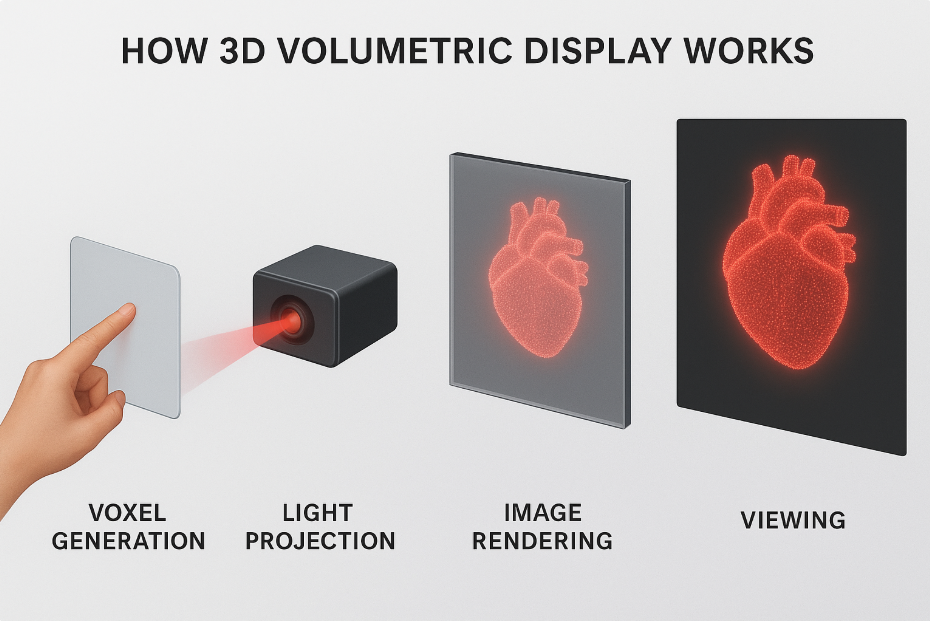
Key Steps in How 3D Volumetric Display Works:
Voxel Generation – A voxel is the smallest unit of a volumetric image, similar to a pixel in 2D screens.
Light Projection – Light beams (lasers, LEDs, or optical fibers) illuminate these voxels.
Image Rendering – The display system refreshes the voxels rapidly, creating smooth 3D visuals.
Viewing – Observers can view the generated 3D object from multiple directions without wearable devices.
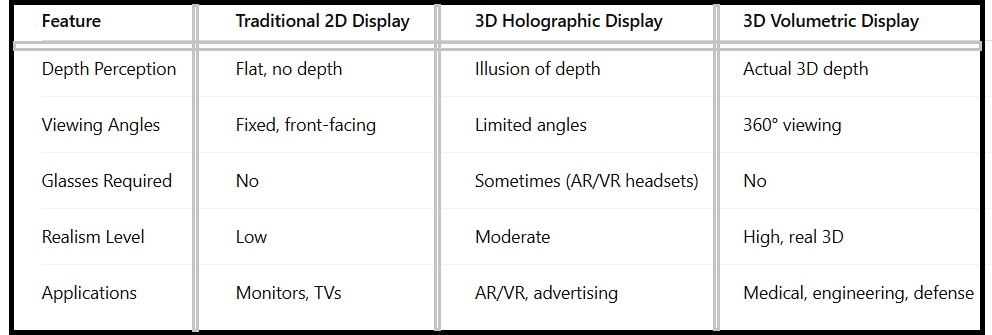
3D Volumetric Display vs Other Display Types:
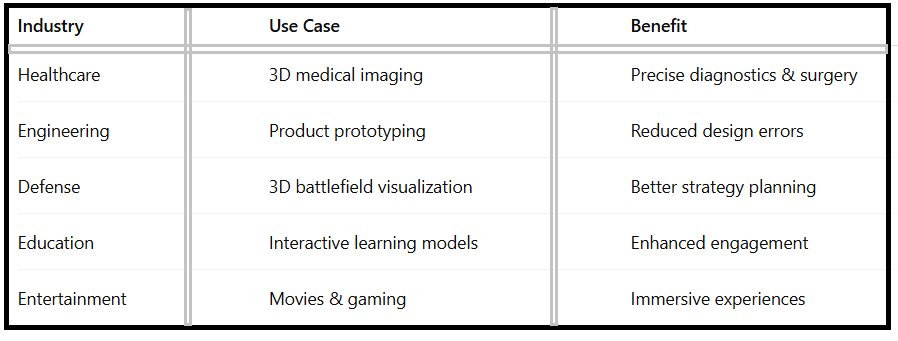
Applications of 3D Volumetric Display:
Volumetric display technology is not just futuristic; it already has real-world uses. Let’s explore where it is being applied today.
Medical Imaging – Surgeons can view organs and tissues in real-time 3D display, aiding precision surgeries.
Engineering & Design – Architects and engineers use volumetric displays to visualize models in 3D before construction.
Education & Training – Students can interact with 3D models of molecules, anatomy, or machinery.
Military & Defense – Real-time 3D battle maps enhance strategic planning.
Entertainment & Gaming – Immersive experiences without headsets.
3D Holographic Display vs Volumetric Display:
There is often confusion between 3D holographic display vs volumetric display. While both technologies create 3D visuals, they operate differently.
Holographic Displays: Depend on interference patterns of light to simulate depth.
Volumetric Displays: Generate actual 3D structures in space.
Thus, volumetric displays provide a more authentic experience since viewers can move around them.
Real-Time 3D Display Capabilities:
One of the most exciting aspects of volumetric display technology is its ability to handle real-time 3D display. For instance, during medical surgeries, doctors can access live 3D models of patient organs. In defense, commanders can monitor battlefields with dynamic 3D visualizations.
Future of 3D Displays:
The future of 3D displays is extremely promising. Current prototypes are becoming more advanced, affordable, and scalable. In the next decade, we may see volumetric displays replacing traditional monitors in hospitals, universities, and even personal devices.
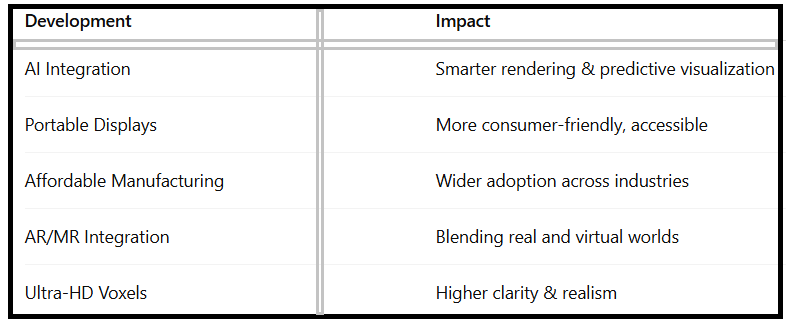
Expected Trends:
-Integration with AI for smarter visual rendering.
-More compact and portable volumetric display units.
-Wider use in augmented reality (AR) and mixed reality (MR).
-Increased adoption in consumer electronics.
Future Developments in Volumetric Display Technology:
Benefits of Using 3D Volumetric Display:
•No glasses or VR headsets required.
•True 360° visualization of objects.
•Improved decision-making in industries like healthcare and defense.
•Immersive learning and training experiences.
•Better engagement in entertainment and advertising.
•Challenges in Volumetric Display Technology
•High production cost.
•Limited resolution compared to 2D screens.
•Large hardware requirements.
•Still in early development stages for mass-market use.
FAQ – What Is 3D Volumetric Display and How It Works
Q1.What is 3D Volumetric Display?
A 3D volumetric display creates real 3D images in space using illuminated voxels, visible from any angle without special glasses.
Q2.How does 3D Volumetric Display work?
It projects light onto voxels in 3D space, rapidly refreshing them to form complete 3D visuals.
Q3.What are the main applications of volumetric display technology?
Medical imaging, education, defense, engineering, and entertainment.
Q4.How is volumetric display different from holographic display?
Holograms simulate depth using light interference, while volumetric displays generate real 3D objects in space.
Q5.What is the future of 3D displays?
Expect more affordable, portable, and AI-powered volumetric displays integrated into industries and consumer devices.
Conclusion:
The 3D Volumetric Display is not just a technological buzzword—it’s a game-changing innovation that transforms how we interact with digital content. From medical imaging to entertainment, and from education to defense, volumetric display technology is opening up new possibilities for visualization. As manufacturing advances and costs decrease, the future of 3D displays looks brighter than ever, bringing us closer to a world where 3D content becomes part of our everyday lives.