Difference Between Endpoint Security and Antivirus. Cyberattacks are evolving faster than ever. A few years ago, installing a simple antivirus program felt enough for most users. Today? Not really. Businesses face sophisticated ransomware attacks, phishing campaigns, and hidden malware that traditional tools often miss. That’s why understanding the Difference Between Endpoint Security and Antivirus has become essential for both companies and individual users.
Many people still assume these two terms mean the same thing. They don’t. While both focus on protecting systems, the scope, technology, and overall defense strategy are very different.
In this guide, we’ll break everything down in simple language. You’ll learn how endpoint protection platform solutions work, where traditional antivirus still fits, and why modern organizations are shifting toward smarter cybersecurity protection solutions for stronger cyber threat prevention and data breach protection.
What Is Antivirus Software?
Antivirus software is one of the oldest forms of digital security. Its primary job is simple: detect and remove malicious software.
Traditional antivirus programs rely heavily on virus signatures. In other words, they compare files against a database of known threats. If there’s a match, the file gets quarantined or deleted.
Most antivirus software for business also includes:
- Real-time malware scanning
- Basic firewall support
- Spyware removal
- Email scanning
- Scheduled scans
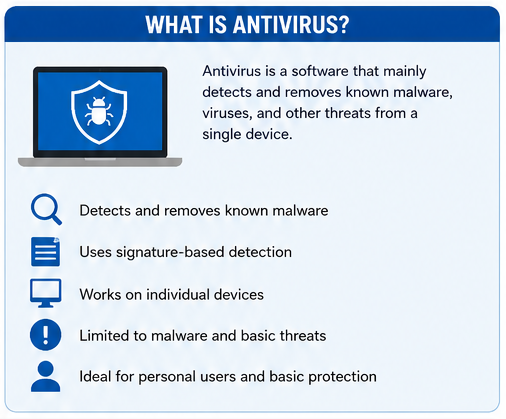
For home users, antivirus software still offers decent protection against common threats. But modern attacks have changed dramatically. Hackers now use fileless malware, AI-driven phishing, and zero-day exploits that traditional antivirus software sometimes struggles to detect.
That’s where endpoint security enters the picture.
What Is Endpoint Security?
Endpoint security is a broader and far more advanced security approach. Instead of protecting only one computer from viruses, it secures every endpoint connected to a network.
Endpoints include:
- Laptops
- Smartphones
- Servers
- Tablets
- Remote work devices
- IoT systems
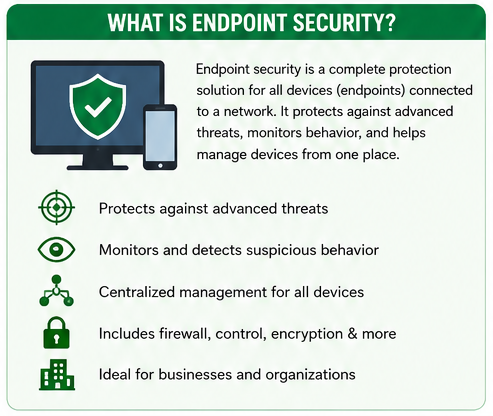
An endpoint protection platform combines multiple layers of protection into one centralized system. It doesn’t just look for viruses — it actively monitors suspicious behavior, blocks threats in real time, and helps IT teams manage company-wide security.
Modern enterprise cybersecurity solutions often include:
- Endpoint threat detection
- Behavioral analysis
- Device monitoring
- AI-based security
- Cloud management
- Zero-day threat protection
- Data encryption
- Threat intelligence
This is why businesses increasingly prefer cloud-based endpoint security over standalone antivirus software.
Difference Between Endpoint Security and Antivirus in Simple Terms
The easiest way to understand the Difference Between Endpoint Security and Antivirus is this:
Antivirus protects a single device from known malware. Endpoint security protects an entire network ecosystem from advanced threats.
Here’s a clearer comparison.
| Feature | Antivirus | Endpoint Security |
|---|---|---|
| Main Purpose | Virus removal | Full endpoint protection |
| Threat Detection | Signature-based | AI + behavioral analysis |
| Management | Individual device | Centralized dashboard |
| Best For | Personal users | Businesses & enterprises |
| Remote Protection | Limited | Strong |
| Advanced Threat Defense | Basic | High |
| Cloud Support | Minimal | Extensive |
You can already see why the discussion around network security vs antivirus has become so important for organizations.
Why Businesses Are Moving Beyond Traditional Antivirus
Modern businesses operate differently now. Employees work remotely. Data moves through cloud apps. Teams access sensitive files from personal devices.
This creates dozens — sometimes hundreds — of endpoints.
Traditional antivirus simply wasn’t built for this level of complexity.
A modern endpoint protection platform offers centralized monitoring, automated alerts, and better enterprise threat monitoring. If suspicious behavior appears on one device, security teams can isolate that endpoint before malware spreads across the network.
That’s a game-changer.
Honestly, many small businesses still underestimate this risk until they experience downtime or a ransomware attack. Unfortunately, by then, recovery becomes expensive.
Difference Between Endpoint Security and Antivirus for Threat Detection
One major area where the Difference Between Endpoint Security and Antivirus becomes obvious is threat detection capability.
Traditional antivirus software depends heavily on known virus databases. That means new threats can sometimes bypass protection until updates are released.
Endpoint security takes a different approach.
It uses:
- Machine learning
- Behavioral monitoring
- AI-based analytics
- Threat intelligence feeds
This enables better malware detection and prevention, even for previously unknown attacks.
Comparison of Detection Methods
| Security Method | Antivirus | Endpoint Security |
|---|---|---|
| Signature Scanning | Yes | Yes |
| Behavioral Analysis | Limited | Advanced |
| AI Threat Detection | Rare | Common |
| Fileless Attack Protection | Weak | Strong |
| Zero-day threat protection | Minimal | Advanced |
| Automated Incident Response | No | Yes |
Modern advanced endpoint security tools can even identify unusual employee behavior patterns that may indicate compromised credentials.
That’s far beyond what traditional antivirus software was originally designed to do.
Antivirus vs Endpoint Protection: Which Is Better?
The answer depends on your needs.
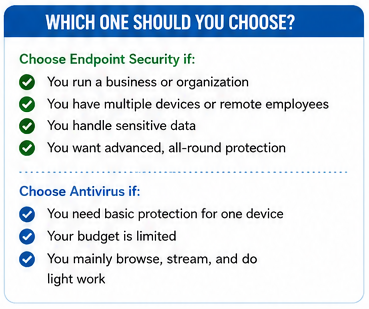
For a single home computer used mainly for browsing and streaming, an antivirus may still be enough. But for businesses handling sensitive customer data, endpoint security is usually the smarter investment.
Here’s why antivirus vs endpoint protection matters today:
Antivirus Works Well For:
- Basic malware protection
- Personal devices
- Budget-friendly security
- Simple use cases
Endpoint Security Works Better For:
- Remote teams
- Large organizations
- Regulatory compliance
- Multi-device environments
- Strong business device security
- Advanced IT infrastructure security
In real-world scenarios, endpoint security simply offers more depth.
The Role of Cloud-Based Endpoint Security
One of the biggest trends right now is cloud-based endpoint security.
Older antivirus programs required manual updates and local management. Cloud-based solutions simplify everything.
Benefits include:
- Centralized management
- Faster updates
- Remote monitoring
- Better scalability
- Lower hardware burden
This is especially useful for companies with remote employees spread across multiple locations.
Honestly, cloud-managed security has become almost necessary after the rise of hybrid work environments.
How Endpoint Security Helps Prevent Ransomware
Ransomware attacks have exploded over the last few years. Traditional antivirus sometimes catches ransomware after infection begins — which is already too late.
Modern ransomware protection software inside endpoint security solutions works proactively.
It can:
- Detect suspicious encryption activity
- Stop unauthorized file modifications
- Isolate infected devices
- Roll back malicious changes
That level of response dramatically improves data breach protection.
Here’s a quick comparison.
| Ransomware Defense Feature | Antivirus | Endpoint Security |
|---|---|---|
| Detect Known Ransomware | Yes | Yes |
| Detect Unknown Variants | Limited | Advanced |
| Device Isolation | No | Yes |
| Rollback Features | Rare | Common |
| Network-wide Protection | Weak | Strong |
| Centralized Incident Management | No | Yes |
This is another major Difference Between Endpoint Security and Antivirus businesses should understand.
Next-Generation Antivirus (NGAV) Explained
The security industry has also evolved traditional antivirus into something smarter called next-generation antivirus (NGAV).
NGAV combines:
- AI detection
- Machine learning
- Behavioral analytics
- Threat intelligence
In many ways, NGAV acts as a bridge between traditional antivirus and full endpoint security.
Still, endpoint security remains more comprehensive because it also includes:
- Endpoint device management
- Threat response tools
- Policy enforcement
- Centralized administration
So while NGAV is impressive, it usually works best as part of larger enterprise cybersecurity solutions.
Key Factors to Consider Before Choosing a Solution
Before selecting any security product, businesses should ask:
How many devices need protection?
A small office may manage with NGAV. A larger company probably needs complete endpoint security.
Are employees working remotely?
Remote teams increase endpoint exposure dramatically.
Is sensitive customer data involved?
If yes, stronger cybersecurity protection solutions become essential.
What is the IT budget?
Endpoint security costs more upfront but often saves money long term by reducing breaches and downtime.
Does the organization need centralized management?
This is one area where endpoint security clearly wins.
Difference Between Endpoint Security and Antivirus: Final Verdict
At first glance, antivirus and endpoint security might seem similar. Both aim to stop malware and protect systems. But the Difference Between Endpoint Security and Antivirus becomes very clear once you look deeper.
Antivirus focuses mainly on detecting known threats on individual devices. Endpoint security takes a broader, smarter, and more proactive approach. It protects entire networks, strengthens enterprise threat monitoring, improves cyber threat prevention, and supports modern IT infrastructure security requirements.
For personal users, an antivirus may still be enough. But for businesses dealing with remote work, sensitive customer information, and evolving cyber risks, endpoint security has become almost essential.
The digital threat landscape simply isn’t what it used to be.
And honestly? Relying only on traditional antivirus feels a bit like locking your front door while leaving every window open.
FAQ
Is endpoint security better than antivirus?
Yes, endpoint security provides broader protection by securing entire networks and detecting advanced threats beyond traditional malware.
Can an antivirus stop ransomware?
Basic antivirus can stop known ransomware, but modern endpoint security offers stronger ransomware prevention and response capabilities.
What is the main advantage of endpoint security?
The biggest advantage is centralized protection and advanced threat detection across multiple devices.
Is next-generation antivirus enough for businesses?
Small businesses may benefit from next-generation antivirus (NGAV), but larger organizations usually require full endpoint security solutions.
Does endpoint security include antivirus features?
Yes, most endpoint security platforms include antivirus capabilities along with advanced monitoring and threat response tools.