Difference Between AI Tools Vs Automation Software. At first glance, AI tools vs automation software can seem like the same thing. Both can save time, reduce repetitive work, and help businesses get more done. However, they work in very different ways.
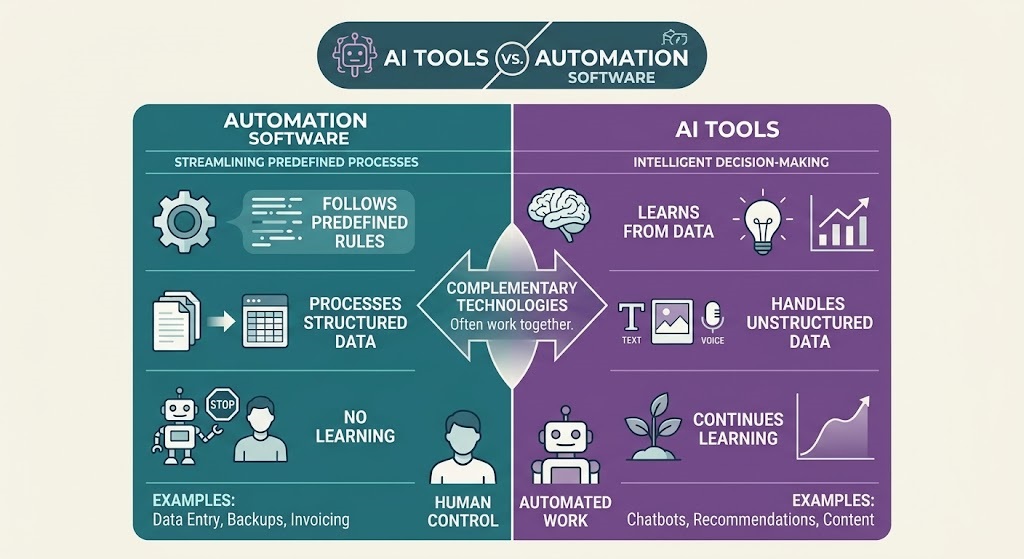
The simplest way to understand the difference between AI tools and automation software is this: automation software generally follows predefined rules, while AI tools can analyze information, recognize patterns, generate content, and make context-based decisions.
For example, a traditional automation tool can send an email whenever a customer fills out a form. An AI tool can read the customer’s message, understand what they need, and draft an appropriate response.
That distinction matters when you’re deciding which technology to use.
What Is the Difference Between AI Tools and Automation Software?
The Difference Between AI Tools Vs Automation Software mainly comes down to how each system handles tasks and decisions.
AI tools use technologies such as machine learning, natural language processing, computer vision, or generative AI to interpret information and produce an output. They can often handle situations where the input isn’t identical every time.
Automation software, on the other hand, usually follows a predefined workflow. You specify a trigger, conditions, and actions, and the software executes those instructions automatically.
| Feature | AI Tools | Automation Software |
|---|---|---|
| How it works | Analyzes data and patterns | Follows predefined rules |
| Decision-making | Can make context-based decisions | Usually rule-based |
| Input | Can handle varied or unstructured information | Works best with predictable inputs |
| Learning | Some systems learn from data | Usually does not learn independently |
| Examples | ChatGPT, AI writing tools, AI assistants | Workflow and task automation platforms |
| Best for | Complex or variable tasks | Repetitive, predictable processes |
In simple terms, AI tools vs automation software isn’t necessarily an either-or decision. In many modern businesses, the two work together.
How Traditional Automation Software Works
Traditional automation software is excellent when you already know exactly what should happen.
Imagine an online store receiving an order. A basic automated workflow might:
- Detect the new order.
- Add the customer to a database.
- Send an order confirmation.
- Notify the warehouse.
- Update the order status.
Every step is predetermined.
This is the strength of rule-based automation. The software doesn’t need to understand the customer’s personality or interpret the order. It simply performs the instructions you’ve configured.
That’s why traditional workflow automation software remains useful for accounting, notifications, data entry, scheduling, inventory updates, and other predictable processes.
Rule-Based Automation vs AI
The difference becomes clearer with customer support.
A rule-based system might say:
If the customer selects “refund,” send the refund instructions.
An AI system can examine the customer’s entire message and determine whether they’re asking for a refund, reporting damaged goods, complaining about delivery, or simply asking a question.
This is the key distinction in rule-based automation vs AI.
Automation asks, “Which rule applies?”
AI can ask, “What does this information mean?”
What Is AI-Powered Automation?
AI-powered automation combines artificial intelligence with automated workflows.
Instead of merely following rigid instructions, the system can use AI to interpret information before deciding what action should happen next.
For example, suppose a company receives hundreds of support emails every day.
Traditional automation might route emails based on keywords such as “refund,” “delivery,” or “payment.”
An AI-powered system can analyze the complete message, identify the customer’s intent, determine its urgency, summarize the issue, and then send it to the appropriate workflow.
This is where AI automation vs workflow automation becomes particularly important.
Traditional workflow automation controls the sequence of actions. AI adds an intelligence layer that can interpret information and make decisions within that workflow.
AI Tools vs Automation Software: Which Is Better?
There isn’t one universal winner.
The better option depends on the problem you’re trying to solve.
Choose automation software for businesses when:
- The task is repetitive.
- The rules are clear.
- The inputs are predictable.
- You need consistent results.
- The process doesn’t require judgment.
Choose AI tools for business automation when:
- Information is unstructured.
- Customers communicate in different ways.
- The task requires interpretation.
- You need content generation.
- Decisions depend on context.
For example, automatically moving a completed invoice into a folder is a good automation task.
Analyzing an invoice and identifying unusual charges is potentially better suited to AI.
AI Automation Use Cases in Business
There are many practical AI automation use cases in business, especially when companies combine AI software with traditional workflows.
Customer Support
AI can categorize incoming requests, summarize conversations, suggest responses, and identify urgent issues.
Content Creation
Generative AI can create drafts for blog posts, product descriptions, emails, and social media content. Automation can then move those drafts through an approval workflow.
Sales
AI can analyze customer messages, identify potential leads, and prioritize prospects. Automation can then add qualified leads to a CRM and schedule follow-up tasks.
Data Processing
AI can extract information from documents, while automation software transfers that information into spreadsheets, databases, or business systems.
Internal Productivity
Employees can use AI tools for repetitive tasks such as summarizing documents, analyzing text, creating reports, or organizing information.
The combination of AI and automated business processes can eliminate a surprising amount of manual work.
AI Tools vs Traditional Automation Software
One common mistake is assuming that AI should replace every automation system.
It shouldn’t.
Traditional automation is often faster, more predictable, and easier to control when the process is completely rule-based. AI is most useful when the system needs to understand information or deal with variation.
For example:
Traditional automation:
“If invoice status = paid → send confirmation.”
AI-driven software:
“Read the invoice and determine whether it appears to have been paid correctly.”
The first task doesn’t need artificial intelligence. Adding AI could actually make the system unnecessarily complicated.
A Better Approach: Combine Both
The most useful modern systems often combine intelligent automation, AI, and conventional workflows.
A customer support system could use AI to understand a message, then use automation to:
- Categorize the request.
- Update the CRM.
- Assign the ticket.
- Notify the appropriate employee.
- Schedule a follow-up.
- Record the interaction.
That is business process automation with AI rather than AI replacing automation completely.
How to Choose Between AI Tools and Automation Software
If you’re unsure which solution you need, use this simple process.
Step 1: Identify the task
Write down exactly what you want the software to accomplish.
Step 2: Ask whether the rules are predictable
If you can describe the entire process using clear “if this, then that” instructions, conventional automation may be enough.
Step 3: Check whether the information needs interpretation
If the system needs to understand language, images, documents, sentiment, or unusual patterns, consider AI.
Step 4: Look for a hybrid solution
Sometimes the best answer is both. AI can make the decision while automation carries out the resulting actions.
Step 5: Consider cost and reliability
Don’t pay for sophisticated AI if a simple automated workflow can accomplish the same thing.
Warning: Don’t introduce AI simply because it sounds more advanced. For predictable tasks, traditional automation can be cheaper, easier to test, and more reliable.
Common Problems When Choosing AI or Automation
| Problem | Likely Cause | Better Approach |
|---|---|---|
| Automation keeps failing | Rules don’t cover every situation | Consider AI for variable inputs |
| AI gives inconsistent answers | Task requires strict rules | Use conventional automation |
| System is too expensive | AI is being used unnecessarily | Reserve AI for complex tasks |
| Workflow needs human approval | Automation is too rigid | Combine AI with human review |
| Data isn’t structured | Traditional automation struggles with it | Use AI for extraction/classification |
This troubleshooting approach can prevent businesses from buying technology they don’t actually need.
Quick Summary
The Difference Between AI Tools Vs Automation Software can be summarized in three points:
- Automation software follows predefined instructions to perform repetitive tasks.
- AI tools interpret information, recognize patterns, generate outputs, and can make context-dependent decisions.
- AI-powered automation combines both technologies to create smarter automated workflows.
Think of automation as the mechanism that performs the job and AI as the layer that can help determine what the job should be.
Frequently Asked Questions
1. What is the difference between AI tools and automation software?
AI tools can interpret information and generate or predict outputs, while automation software generally follows predefined rules and workflows.
2. Is AI automation the same as workflow automation?
No. Workflow automation normally controls a predefined sequence of actions. AI automation adds artificial intelligence to interpret information or make decisions within that workflow.
3. Are AI tools considered automation tools?
Not necessarily. An AI writing assistant, for example, can generate content without automatically performing actions in another application. When AI is connected to automated workflows, it becomes part of an automation system.
4. What are examples of AI automation tools?
Examples include AI customer-support systems, intelligent document processing platforms, AI-powered CRM workflows, AI assistants, and systems that combine machine learning with business automation software.
5. Is AI better than traditional automation?
Not always. AI vs traditional automation depends on the task. Predictable, repetitive processes are often better handled by traditional automation, while complex or variable tasks can benefit from AI.
6. Can AI and automation software work together?
Yes. In fact, combining them is often the most practical approach. AI can interpret information, while automation software executes the resulting workflow.
7. What is AI workflow automation?
AI workflow automation uses artificial intelligence within an automated process. For example, AI could read an incoming customer email, identify its purpose, and automatically route it to the correct department.
8. How do I choose between AI tools and automation software?
Start by examining the task. If the process follows predictable rules, use automation. If it requires interpretation, classification, prediction, or content generation, AI may be more appropriate. For complex processes, use both.
Final Verdict
The Difference Between AI Tools Vs Automation Software isn’t about deciding which technology is universally better. It’s about matching the technology to the job.
If you’re dealing with predictable, repetitive processes, traditional automation software can usually handle the work efficiently. If the task requires understanding language, analyzing information, generating content, or dealing with unpredictable inputs, AI may be the better choice.
For many businesses, however, the smartest option is AI-powered automation. Let AI handle the parts that require understanding, and let automation handle the repetitive actions that follow.
That combination can turn ordinary workflows into genuinely intelligent systems—without using AI where you simply don’t need it.