What Is Agentic AI Optimization AAIO and How It Works. Artificial Intelligence (AI) has transformed industries by making processes faster, smarter, and more adaptive. However, traditional AI optimization methods often rely on static algorithms that struggle when faced with dynamic environments or resource constraints. This is where Agentic AI Optimization AAIO comes into play. It represents a new era in machine learning where agents make intelligent, context-aware decisions to achieve better performance.
In this comprehensive guide, we’ll explain what is Agentic AI Optimization AAIO, explore how Agentic AI Optimization AAIO works, discuss its framework, and showcase real-world applications. We’ll also highlight how it differs from conventional optimizers and why experts consider it the future of AI optimization.
What Is Agentic AI Optimization AAIO?
At its core, Agentic AI Optimization AAIO is a framework that transforms optimization tasks into agent-environment interactions. Unlike static methods that execute the same optimization strategy regardless of the situation, AAIO uses agent-based optimization in AI to dynamically adapt to challenges.
Instead of following fixed rules, AI agents actively observe, decide, and act based on conditions. This makes optimization far more flexible and resource-aware, especially in scenarios where computational power, memory, or time is limited.
How Agentic AI Optimization AAIO Works:
To understand how does agentic optimization work, let’s break down the process:
Environment Sensing – AI agents collect data from the surrounding system.
Decision-Making – Agents use reinforcement learning and adaptive AI optimization strategies to decide the best move.
Action Execution – The chosen optimization strategy is applied to the problem.
Feedback Loop – Results are evaluated, and the agent adjusts strategies dynamically.
This AAIO framework allows continuous learning, ensuring that AI agents become better at solving problems over time.
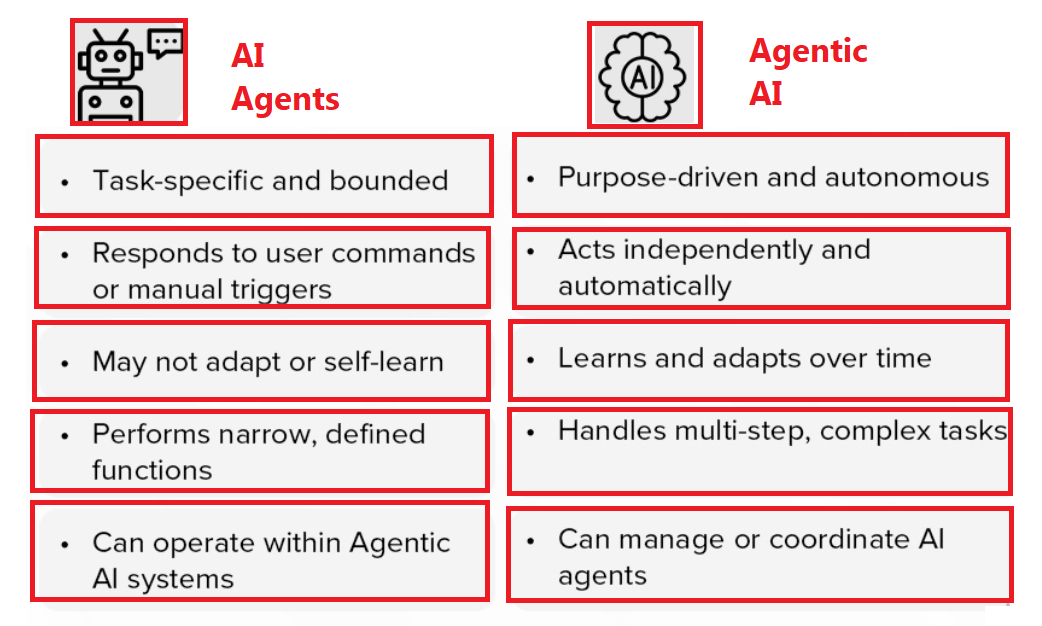
Difference Between AI Agents And Agentic AI:
Although the terms Agentic AI and AI Agents sound similar, they refer to different concepts in artificial intelligence.
1.AI Agents:
An AI agent is a software entity that perceives its environment, processes inputs, and takes actions to achieve a goal.
Nature:
They are tools or components within an AI system.
Example:
A chatbot that answers customer queries or a navigation system that suggests routes.
Focus:
Performing a specific task based on pre-defined logic, reinforcement learning, or optimization rules.
2.Agentic AI:
Agentic AI is an AI paradigm/framework where systems are designed to operate more independently and intelligently, making adaptive, goal-directed decisions.
Nature:
It’s broader than individual agents; it represents an approach to AI system design.
Example:
Agentic AI Optimization (AAIO), where the AI dynamically chooses optimization strategies under resource constraints.
Focus:
Autonomy + adaptability, meaning the AI can self-manage and optimize itself rather than being limited to one task.
Key Differences Between Agentic AI and AI Agents
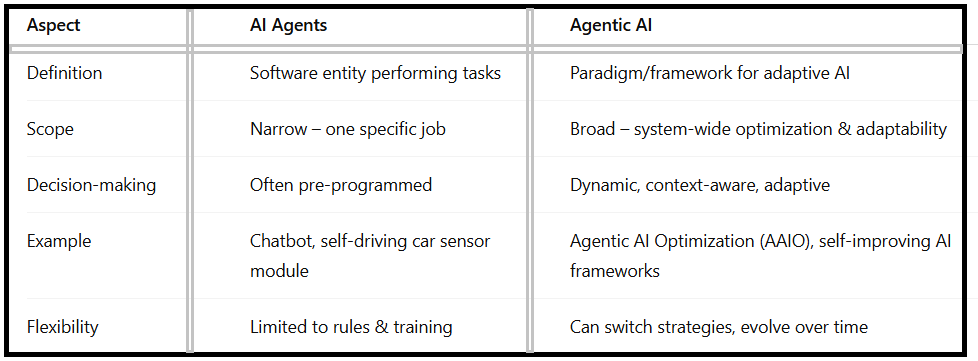
AI Agents = the tools or components that act within an environment.
Agentic AI = the approach/system design that makes agents more autonomous, adaptable, and intelligent.
Traditional Optimization vs Agentic AI Optimization AAIO:
Why Agentic AI Improves Optimization Under Resource Constraints?
One of the most exciting aspects of Agentic AI Optimization AAIO is its ability to handle resource-constrained environments. Traditional methods often fail when computational or energy limits exist, but AAIO thrives under such conditions.
-Dynamic strategy selection prevents wasted resources.
-AI agent optimization methods prioritize efficient use of memory and processing power.
-Agentic AI for problem-solving ensures that the system adapts intelligently rather than rigidly.
This makes AAIO extremely valuable in IoT devices, embedded systems, and edge computing, where resources are limited but real-time decisions are critical.
AAIO in Machine Learning:
In machine learning, the AAIO framework is transforming how models train and improve:
-Agents can choose different optimization algorithms based on the dataset.
-Adaptive AI optimization strategies ensure efficient learning.
-Models become self-adjusting and require fewer manual interventions.
For instance, instead of using a single gradient descent method, an AAIO-driven system can dynamically shift between optimizers depending on model performance.
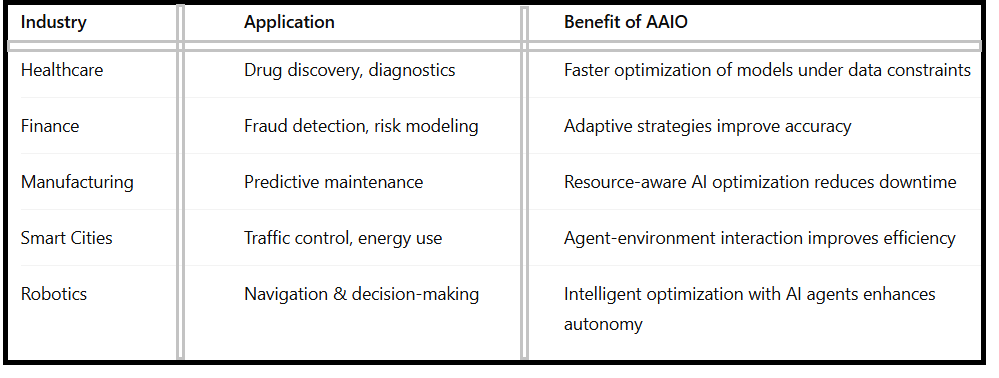
Applications of AAIO in Different Fields:
Difference Between AAIO and Static Optimizers:
A common question is: What is the difference between AAIO and static optimizers?
-Static optimizers like SGD or Adam rely on fixed update rules.
-Agentic AI Optimization AAIO adapts rules on the fly, learning the best approach as conditions change.
-Static methods are efficient for controlled tasks but fail in uncertain environments.
-AAIO thrives in dynamic, real-world systems where adaptability is key.
Intelligent Optimization with AI Agents:
The most powerful aspect of Agentic AI Optimization AAIO lies in its ability to create intelligent optimization with AI agents. Instead of being just mathematical solvers, these agents act like problem-solvers that can:
-Explore multiple strategies.
-Interact with their environment.
-Learn from mistakes and successes.
-Achieve better results with fewer resources.
This shift from rigid algorithms to intelligent agents marks a paradigm shift in AI problem-solving.
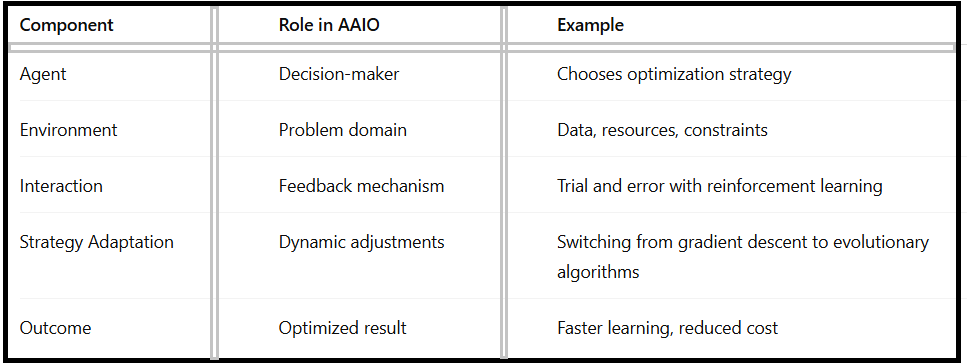
Key Components of the AAIO Framework:
Applications of Agentic AI Optimization AAIO:
The applications of AAIO are wide-ranging:
Healthcare – AI agents can optimize drug discovery models with fewer computational costs.
Finance – Fraud detection becomes more accurate under real-time constraints.
Robotics – Robots can navigate complex environments by continuously adapting.
Energy Management – Smart grids use AAIO to balance loads dynamically.
Cybersecurity – Adaptive threat detection powered by AAIO improves resilience.
Future of AI Optimization with AAIO:
Looking ahead, the future of AI optimization will likely be dominated by AAIO-driven methods. As systems become more complex and resource-constrained, agent-environment interaction in AI will be critical.
Some predictions include:
-Self-maintaining AI systems that require minimal human oversight.
-Cross-domain optimizers that can transfer learning across industries.
-Stronger AI problem-solving abilities where agents evolve new strategies never explicitly programmed.
In short, Agentic AI Optimization AAIO represents not just an upgrade, but a complete transformation in how AI approaches optimization.
FAQ – Agentic AI Optimization AAIO:
Q1:What is AAIO in simple terms?
AAIO (Agentic AI Optimization) is a method where AI agents dynamically decide how to optimize problems instead of following fixed strategies.
Q2:How does Agentic AI Optimization AAIO work?
It works through agent-environment interaction, where agents collect data, make decisions, act, and adapt strategies based on feedback.
Q3:What is the difference between AAIO and static optimizers?
Static optimizers follow fixed rules, while AAIO adapts dynamically, making it more effective in uncertain environments.
Q4:What are the applications of AAIO?
AAIO is applied in healthcare, finance, robotics, manufacturing, and smart cities for efficient and adaptive optimization.
Q5:Is AAIO the future of AI optimization?
Yes, because it provides resource-aware, intelligent optimization strategies that outperform static methods in real-world scenarios.
Conclusion:
We’ve explored what is Agentic AI Optimization AAIO and how it works, its framework, and how it improves optimization under resource constraints. From healthcare to robotics, its applications are vast, and its ability to adapt dynamically makes it a powerful alternative to traditional static optimizers.
By embracing adaptive AI optimization strategies and intelligent agents, businesses and researchers alike can achieve breakthroughs in performance and efficiency. It’s clear that the future of AI optimization is agentic, dynamic, and far more powerful than ever before.