Difference Between VPN and Zero Trust Security. Cybersecurity has changed dramatically over the last decade. Not long ago, organizations relied heavily on Virtual Private Networks (VPNs) to provide employees with secure access to corporate resources. However, the rise of cloud computing, remote work, and sophisticated cyber threats has exposed several weaknesses in traditional security models.
Today, many organizations are exploring the Difference Between VPN and Zero Trust Security to determine which approach best protects their data and users. While VPNs were once considered the gold standard for secure network access, modern businesses increasingly favor Zero Trust Network Access (ZTNA) and other advanced security strategies.
But is Zero Trust really better than a VPN? Or do both solutions serve different purposes?
This guide explores the Difference Between VPN and Zero Trust Security, compares their strengths and weaknesses, and explains why companies are adopting a more modern security approach. Throughout the discussion, concepts such as Context-aware access control, Device trust verification, Risk-based authentication, Modern cybersecurity framework, and Advanced threat protection will help illustrate how security is evolving.
Understanding the Difference Between VPN and Zero Trust Security
Before comparing the two models, it’s important to understand how each one works.
A VPN creates an encrypted tunnel between a user’s device and a corporate network. Once connected, the user often gains broad access to internal resources.
Zero Trust Security, on the other hand, follows a simple principle:
Never trust, always verify.
Instead of automatically trusting users after login, Zero Trust continuously validates identity, device health, location, and behavior before granting access.
This approach relies heavily on Identity-based security, Continuous authentication, Multi-factor authentication (MFA), and Least privilege access to minimize risk.
Basic Overview
| Feature | VPN | Zero Trust Security |
|---|---|---|
| Trust Model | Trust after login | Verify continuously |
| Access Scope | Broad network access | Resource-specific access |
| Authentication | Usually one-time login | Continuous verification |
| Network Exposure | Higher | Minimal |
| Cloud Compatibility | Moderate | Excellent |
| Security Level | Good | Advanced |
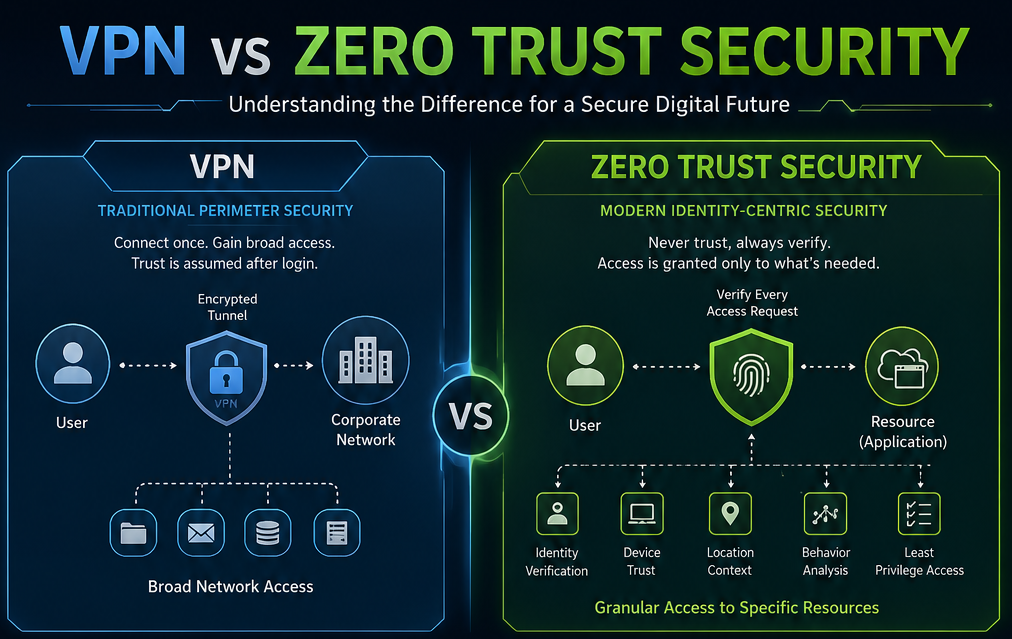
VPN vs Zero Trust Security: How They Work
When discussing VPN vs Zero Trust Security, the core difference lies in trust.
A VPN assumes that authenticated users can be trusted inside the network perimeter. Once connected, users may access multiple resources depending on permissions.
Zero Trust eliminates implicit trust entirely.
Instead of granting network-level access, Zero Trust grants access only to specific applications or services. Every access request is evaluated using factors such as:
- User identity
- Device health
- User behavior
- Geographic location
- Security policies
This creates a much stronger Modern cybersecurity framework that adapts to evolving threats.
For example, if an employee logs in from a new device, Device trust verification mechanisms may require additional authentication before access is granted.
Traditional VPN vs Modern Security Models
The shift from Traditional VPN vs Modern Security Models is largely driven by changing business environments.
Years ago, most employees worked inside office networks. Security teams focused on protecting a fixed perimeter.
Today, employees work from:
- Home offices
- Coffee shops
- Airports
- Shared workspaces
Applications are also hosted across multiple cloud platforms.
As a result, traditional perimeter-based security is becoming less effective.
Common Traditional VPN Limitations
| Limitation | Impact |
|---|---|
| Broad network access | Increased attack surface |
| Performance bottlenecks | Slower user experience |
| Limited cloud integration | Security gaps |
| Difficult scalability | Higher management costs |
| Single authentication event | Greater risk of compromised sessions |
These Traditional VPN limitations have encouraged organizations to look for alternatives that provide better visibility and control.
Benefits of Zero Trust Network Access
One of the biggest reasons organizations are adopting Zero Trust Network Access (ZTNA) is its ability to reduce risk while improving user experience.
1. Least Privilege Access
Users only receive access to the resources they actually need.
This principle of Least privilege access significantly reduces insider threats and accidental data exposure.
2. Continuous Authentication
Unlike VPNs, Zero Trust doesn’t stop verifying users after login.
Through Continuous authentication, the system constantly evaluates risk signals and user behavior.
3. Better Cloud Security
Modern businesses rely heavily on cloud applications.
A strong Cloud security architecture integrates naturally with Zero Trust environments and protects distributed workloads.
4. Stronger Identity Protection
Zero Trust emphasizes Identity and access management (IAM) and Multi-factor authentication (MFA) to ensure users are properly verified.
5. Enhanced Threat Detection
By incorporating Risk-based authentication, organizations can detect suspicious behavior and respond faster to attacks.
Why Businesses Are Moving to Zero Trust
The question isn’t just about security anymore.
It’s also about operational efficiency.
Growing Cyber Threats
Cybercriminals have become increasingly sophisticated. Compromised credentials remain one of the most common attack vectors.
Zero Trust reduces this risk by enforcing:
- Context-aware access control
- Continuous identity verification
- Application-level security policies
Rise of Remote Work
The global shift toward flexible work arrangements has increased demand for stronger Remote access security.
VPNs were not originally designed for today’s cloud-first workforce.
Zero Trust addresses these challenges by protecting users wherever they work.
Improved Compliance
Many regulatory frameworks require strict access controls.
Organizations using Identity-based security and Network segmentation often find compliance easier to achieve.
Why Organizations Prefer Zero Trust
| Business Need | VPN | Zero Trust |
|---|---|---|
| Remote Workforce Support | Moderate | Excellent |
| Cloud Adoption | Limited | Strong |
| Insider Threat Protection | Moderate | High |
| Compliance Readiness | Good | Excellent |
| Security Visibility | Limited | Advanced |
Zero Trust Security for Remote Work
The rise of remote and hybrid work has transformed cybersecurity priorities.
Zero Trust Security for Remote Work enables organizations to protect employees without requiring full network access.
Instead of connecting workers directly to corporate networks, Zero Trust grants access only to approved applications.
This approach improves:
- Secure remote workforce management
- Productivity
- User experience
- Security visibility
For companies supporting Cybersecurity for hybrid work, Zero Trust provides flexibility while maintaining strict access controls.
Employees can securely access resources from virtually any location without exposing the entire corporate network.
The Role of Secure Access Service Edge (SASE)
Many organizations combine Zero Trust principles with Secure Access Service Edge (SASE) solutions.
SASE integrates networking and security services into a unified cloud platform.
It often includes:
- Zero Trust Network Access (ZTNA)
- Secure web gateways
- Cloud access security brokers
- Firewall-as-a-Service
This combination creates a scalable security architecture that supports modern business operations.
Organizations seeking Secure network access for distributed teams frequently adopt SASE as part of their Zero Trust strategy.
VPN vs Zero Trust: Which Is More Secure?
When comparing VPN vs Zero Trust, security experts generally consider Zero Trust the more advanced model.
Why?
Because VPNs focus on protecting connections.
Zero Trust focuses on protecting resources.
Zero Trust combines:
- Identity-based security
- Continuous authentication
- Network segmentation
- Context-aware access control
- Advanced threat protection
Together, these controls reduce the chances of lateral movement by attackers.
Even if an account is compromised, access remains restricted.
VPNs still have value, especially for smaller organizations with simpler infrastructures. However, for cloud-first enterprises, Zero Trust offers significantly stronger protection.
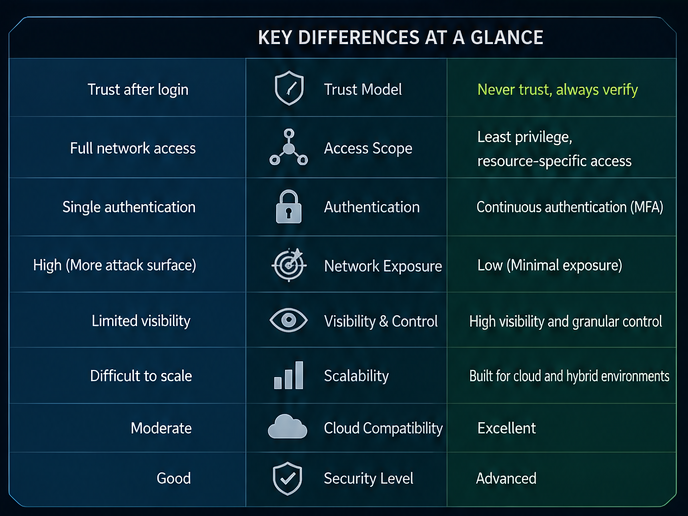
Key Differences at a Glance
The Difference Between VPN and Zero Trust Security ultimately comes down to philosophy.
VPNs trust authenticated users and protect network connections.
Zero Trust assumes every request could be risky and requires continuous verification.
Organizations embracing Zero Trust Network Access (ZTNA) gain better visibility, stronger security controls, and improved adaptability in modern digital environments.
As cyber threats continue to evolve, businesses increasingly view Zero Trust not as a future technology, but as a present necessity.
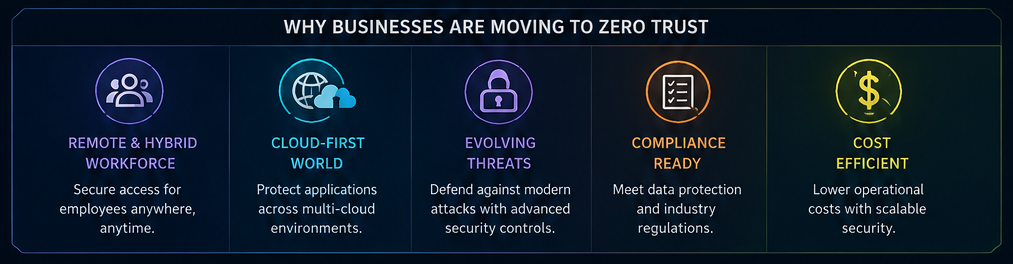
Conclusion
Understanding the Difference Between VPN and Zero Trust Security is essential for organizations navigating today’s threat landscape. While VPNs remain useful for encrypted connectivity, they were designed for a very different era of networking.
Modern businesses require stronger Remote access security, smarter Identity and access management (IAM), and more flexible Cloud security architecture. This is where Zero Trust excels.
With features such as Context-aware access control, Device trust verification, Risk-based authentication, and Advanced threat protection, Zero Trust provides a more resilient security model for cloud-first and hybrid work environments.
As organizations continue adopting digital transformation strategies, the shift from traditional VPNs to Zero Trust will likely accelerate. For many businesses, the future of Secure network access lies not in trusting users after login, but in verifying every request, every time.
FAQ
1. What is the main Difference Between VPN and Zero Trust Security?
A VPN provides encrypted access to a network, while Zero Trust continuously verifies users and devices before granting access to specific resources.
2. Is Zero Trust more secure than a VPN?
In most modern environments, yes. Zero Trust uses Continuous authentication, Least privilege access, and Identity-based security to reduce risks.
3. What is Zero Trust Network Access (ZTNA)?
Zero Trust Network Access (ZTNA) is a security model that grants users access only to approved applications instead of the entire network.
4. Can VPN and Zero Trust work together?
Yes. Many organizations use VPNs alongside Zero Trust solutions during migration or as part of broader security architectures.
5. Why are businesses moving to Zero Trust?
Organizations are adopting Zero Trust because it offers stronger protection, better cloud integration, improved compliance, and enhanced support for remote and hybrid workforces.