Difference Between Machine Learning and AI. Artificial intelligence is everywhere now. From chatbots and recommendation systems to self-driving cars and fraud detection, modern technology depends heavily on smart systems. But many people still confuse Machine Learning with Artificial Intelligence. Some even use the terms interchangeably. Honestly, that confusion is understandable because both technologies are deeply connected.
Still, understanding the Difference Between Machine Learning and AI is important, especially if you work in tech, digital marketing, automation, cybersecurity, or business analytics.
In simple words, Artificial Intelligence is the broader concept, while Machine Learning is a subset of AI. But there’s much more to it than that. Let’s break it down in a practical and easy-to-understand way.
What Is Artificial Intelligence?
Before understanding the Difference Between Machine Learning and AI, you first need to understand what is artificial intelligence.
Artificial Intelligence (AI) refers to computer systems designed to mimic human intelligence. These systems can perform tasks such as reasoning, learning, problem-solving, language understanding, and decision-making.
Think about voice assistants, facial recognition, or autonomous vehicles. These are examples of AI-powered systems built using cognitive computing and smart automation systems.
AI is not limited to one technology. It combines several fields including:
- Machine learning
- Robotics
- Expert systems
- Natural language processing
- Computer vision
- Neural networks
The goal is simple: create intelligent machines that can perform tasks normally requiring human intelligence.
What Is Machine Learning?
Now let’s discuss what is machine learning.
Machine Learning (ML) is a branch of AI that enables computers to learn from data without being explicitly programmed. Instead of following hardcoded instructions, ML systems analyze patterns and improve over time.
For example, Netflix recommendations, spam email filters, and product suggestions on eCommerce stores use machine learning algorithms to predict user behavior.
This technology relies heavily on:
- Data collection
- Pattern recognition
- Predictive analytics
- Training models
- Adaptive learning technology
In many ways, ML is the engine powering modern AI applications.
How Machine Learning Works
Machine Learning systems learn through data training. The system studies historical information and improves its predictions over time.
This process includes:
- Data collection
- Data cleaning
- Training machine learning models
- Testing accuracy
- Continuous improvement
The more high-quality data available, the better the system becomes.
Modern businesses now depend heavily on data-driven decision making because ML can identify trends humans often miss.
Difference Between Machine Learning and AI Explained
The core Difference Between Machine Learning and AI lies in their scope and functionality.
AI focuses on making machines intelligent, while ML focuses on enabling systems to learn from data.
Here’s a simple analogy:
AI is the entire car, while Machine Learning is the engine inside it.
Sounds simple? It actually is.
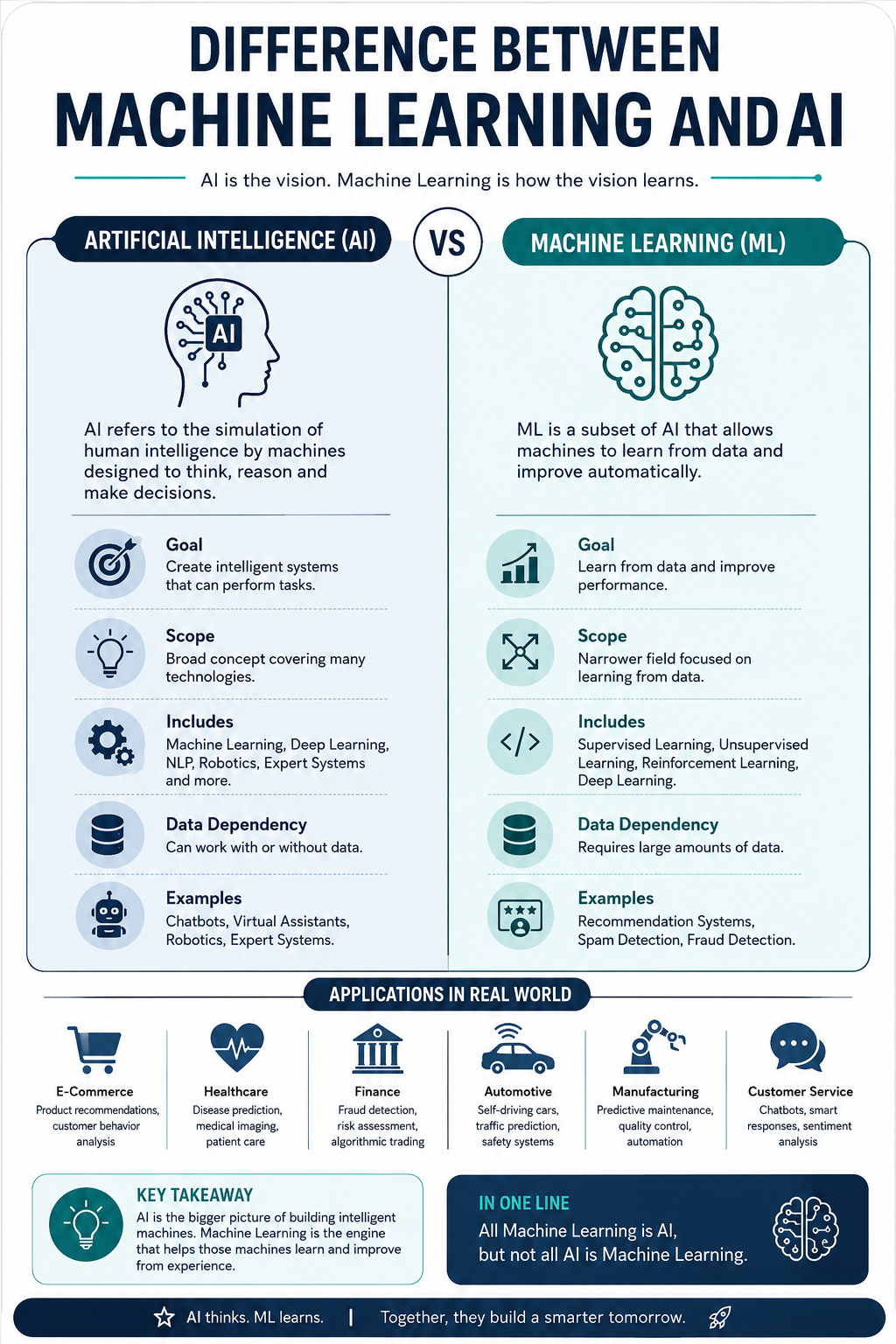
Artificial Intelligence vs Machine Learning
| Feature | Artificial Intelligence | Machine Learning |
|---|---|---|
| Definition | Simulation of human intelligence | Subset of AI that learns from data |
| Main Goal | Create smart systems | Improve accuracy through learning |
| Dependency | Can work without ML | Cannot exist without AI |
| Data Usage | Sometimes optional | Data is essential |
| Examples | Chatbots, robots, virtual assistants | Recommendation engines, fraud detection |
| Complexity | Broader concept | Narrower implementation |
| Decision Style | Rule-based + learning-based | Mainly data-driven |
This comparison clearly highlights the Artificial Intelligence vs Machine Learning debate.
Types of Artificial Intelligence
Understanding the types of artificial intelligence also helps clarify the AI and ML relationship.
AI is generally divided into three categories:
1. Narrow AI
Designed for specific tasks only.
Examples:
- Siri
- Alexa
- Google Translate
This is the most common AI today.
2. General AI
A theoretical form of AI capable of human-level intelligence across multiple tasks.
We are not fully there yet.
3. Super AI
A future concept where AI surpasses human intelligence entirely.
Sounds futuristic, but researchers are actively exploring it.
Types of Machine Learning
To better understand the AI and ML difference, let’s examine the major ML categories.
1. Supervised Learning
In supervised learning, the model is trained using labeled data.
Example:
- Spam email detection
- House price prediction
The system already knows the correct answers during training.
2. Unsupervised Learning
In unsupervised learning, the system works with unlabeled data and identifies hidden patterns.
Examples:
- Customer segmentation
- Behavioral analytics
This is widely used in marketing and predictive analytics.
3. Reinforcement Learning
The system learns through rewards and penalties.
Used in:
- Robotics
- Gaming AI
- Self-driving cars
Deep Learning vs Machine Learning
Another topic people frequently ask about is deep learning vs machine learning.
Deep Learning is actually a specialized branch of Machine Learning that uses neural networks with multiple layers.
Traditional ML requires some human intervention, but deep learning models can process massive datasets automatically.
Key Difference
- Machine Learning works with structured data
- Deep Learning handles complex and unstructured data better
For example:
| Technology | Best For |
|---|---|
| Machine Learning | Sales prediction |
| Deep Learning | Image recognition, speech AI |
Deep learning powers modern innovations like ChatGPT, facial recognition, and advanced voice assistants.
Real-World AI Applications in Business
Businesses are investing billions into AI because the benefits are enormous.
Modern AI applications in business include:
- Customer support chatbots
- Fraud detection systems
- Personalized marketing
- Inventory management
- Predictive maintenance
- Intelligent automation
Honestly, many companies now rely on AI even without realizing it fully.
For example, eCommerce stores use machine learning models to recommend products based on browsing history. Banks use AI to detect suspicious transactions in real time.
This shift toward smart automation systems is transforming nearly every industry.
Role of Neural Networks in AI and ML
Neural networks are inspired by the human brain. They consist of interconnected nodes that process information layer by layer.
These networks are essential for:
- Speech recognition
- Image analysis
- Natural language processing
- Medical diagnosis
Without neural networks, modern AI systems would be far less powerful.
Difference Between Machine Learning and AI in Practical Terms
Let’s make the Difference Between Machine Learning and AI even simpler with a real-world example.
Imagine a smart assistant app.
AI Part:
The assistant understands voice commands and interacts naturally.
Machine Learning Part:
The app learns your habits over time and improves recommendations.
That’s the easiest way to understand the relationship.
Practical AI vs ML Examples
| Scenario | AI Function | ML Function |
|---|---|---|
| Netflix | Personalized platform | Learns viewing preferences |
| Self-driving Cars | Navigation decisions | Learns driving patterns |
| Email Spam Filter | Detects harmful emails | Improves detection accuracy |
| Chatbots | Human-like conversation | Learns customer responses |
| Banking Systems | Fraud prevention | Detects unusual patterns |
Data Science and AI Relationship
Many people also connect data science and AI together.
Data Science focuses on analyzing and interpreting data. AI uses that data to simulate intelligent behavior.
In simple terms:
- Data Science extracts insights
- Machine Learning learns patterns
- AI makes decisions
These technologies work together rather than competing.
Why Businesses Prefer Machine Learning
Companies increasingly prefer Machine Learning because it adapts quickly.
Benefits include:
- Better customer targeting
- Faster automation
- Improved forecasting
- Reduced operational costs
- Real-time decision-making
Modern enterprises now rely heavily on adaptive learning technology because static systems simply cannot keep up with changing user behavior.
Future of AI and Machine Learning
The future looks massive.
AI tools are becoming smarter every year. Healthcare, cybersecurity, education, and finance are rapidly evolving due to AI innovation.
Experts believe future systems will combine:
- Advanced neural networks
- Cognitive computing
- Intelligent automation
- Real-time predictive analytics
However, ethical concerns also exist. Privacy, job displacement, and algorithm bias remain serious discussions.
Still, there’s no denying that AI and ML will continue shaping the digital world.
Conclusion
Understanding the Difference Between Machine Learning and AI is no longer optional in today’s tech-driven world. Artificial Intelligence focuses on creating systems capable of mimicking human intelligence, while Machine Learning allows those systems to improve automatically through experience and data.
The relationship between AI and ML is close, but they are not identical. AI is the broader concept, and Machine Learning is one of its most powerful tools.
As businesses continue adopting data-driven decision making, smart automation systems, and adaptive learning technology, both AI and ML will become even more important across industries.
If you are entering the tech field, learning these technologies now could seriously benefit your future career.
FAQ
Is Machine Learning the same as AI?
No. Machine Learning is a subset of Artificial Intelligence. AI is the broader field focused on intelligent systems.
What is the main Difference Between Machine Learning and AI?
AI aims to simulate human intelligence, while Machine Learning focuses on learning from data patterns.
Which is better: AI or Machine Learning?
Neither is better. Machine Learning works as part of AI systems.
Are neural networks part of AI?
Yes. Neural networks are important components used in Machine Learning and Deep Learning.
Where is AI mostly used today?
AI is widely used in healthcare, finance, cybersecurity, eCommerce, and customer service automation.