Difference Between VPN Vs Proxy: Which One Is Better? If you want more privacy online, hide your IP address, access location-based content, or simply browse more securely, you have probably come across two common options: a VPN and a proxy. They can look similar at first, but they work quite differently.
The Difference Between VPN Vs Proxy mainly comes down to how they handle your internet traffic. A proxy usually routes traffic from a specific application through another server, while a VPN creates an encrypted connection between your device and a VPN server.
So, VPN vs Proxy — which one should you actually use? The answer depends on whether your priority is privacy, security, speed, streaming, gaming, or simply changing your apparent IP address.
Best VPN Alternatives for Privacy
What Is the Difference Between a VPN and a Proxy?
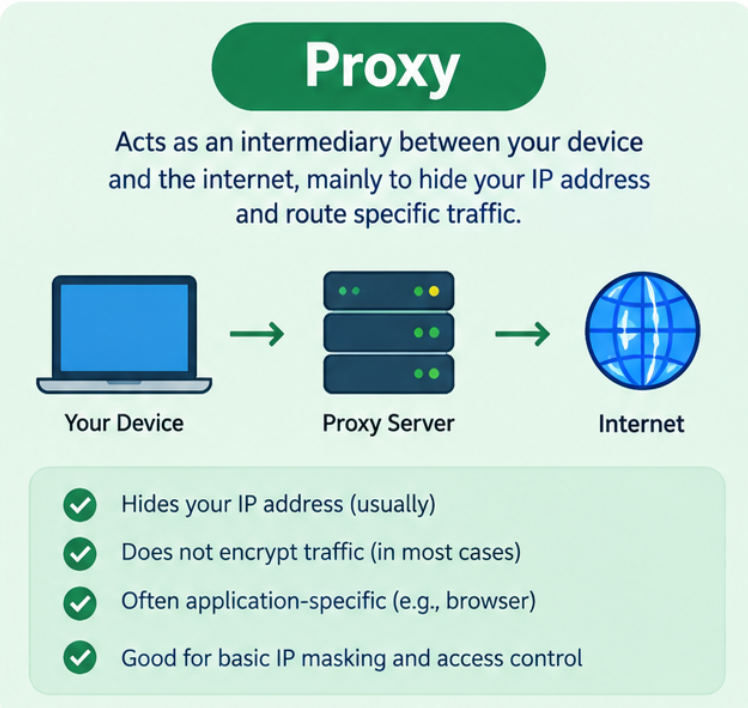
A proxy server acts as an intermediary between your device and the website or online service you are accessing. Instead of connecting directly, your request goes through the proxy server.
A VPN, on the other hand, establishes a secure tunnel between your device and the VPN server. Your internet traffic travels through that tunnel before reaching its destination.
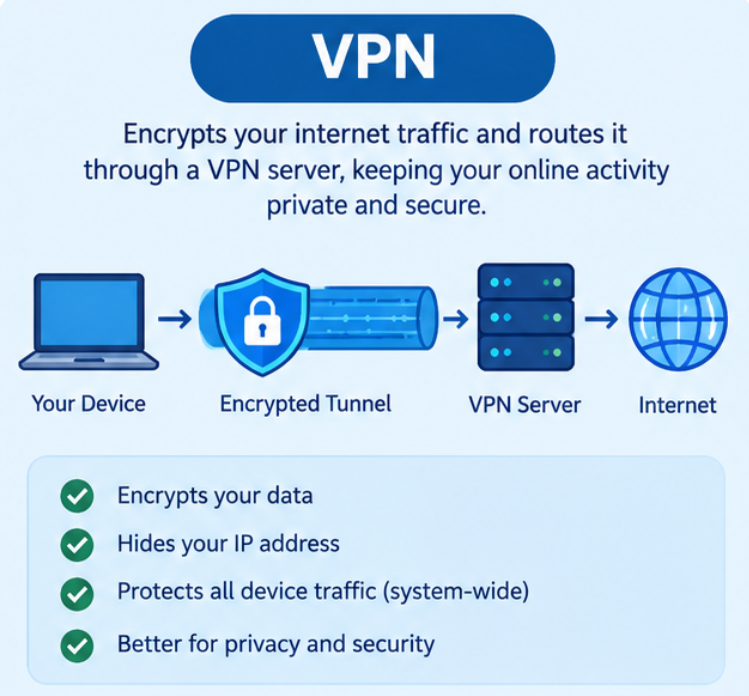
The biggest distinction is encryption. Most reputable VPN services encrypt your traffic, whereas a typical proxy does not automatically encrypt everything leaving your device.
That difference becomes particularly important when using public Wi-Fi, accessing sensitive accounts, or handling private information.
Difference Between VPN Vs Proxy: How Do They Work?
Here is a simple way to visualize the difference.
With a proxy:
Your device → Proxy server → Website
With a VPN:
Your device → Encrypted VPN tunnel → VPN server → Website
A proxy can make a website see the proxy server’s IP address instead of yours. However, the connection between your device and the proxy may not be encrypted.
A VPN goes further by encrypting network traffic before it leaves your device. Your internet service provider can still see that you are connected to a VPN server, but the contents of your encrypted traffic are generally protected from ordinary network inspection.
Does a VPN change your IP address?
Yes. When you connect to a VPN server, websites generally see the public IP address associated with that VPN server rather than your normal public IP address.
Does a proxy hide your IP address?
Usually, yes. A proxy can hide your IP address from the website you visit, but the level of privacy depends heavily on the proxy type, configuration, and application being used.
VPN vs Proxy: Key Differences
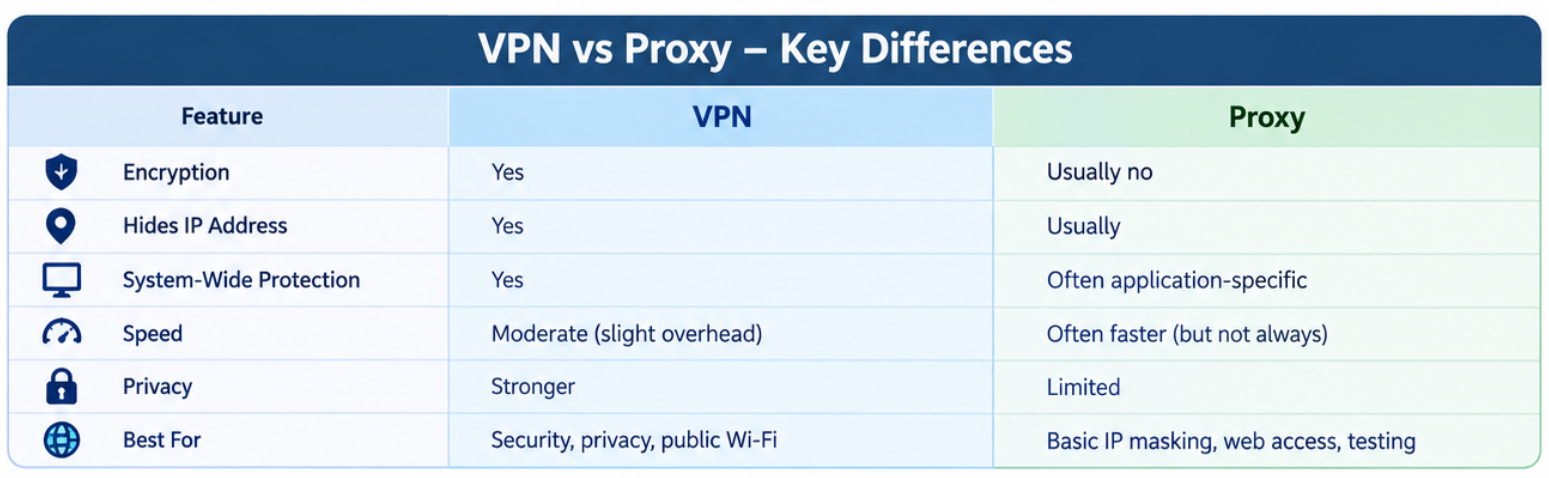
The easiest way to understand the Difference Between VPN Vs Proxy is to compare what each technology actually protects.
| Feature | VPN | Proxy |
|---|---|---|
| Hides IP address | Yes | Usually |
| Encrypts traffic | Yes, with reputable VPNs | Usually no |
| Protects system-wide traffic | Usually | Often application-specific |
| Improves privacy | Stronger | Limited |
| Setup | Easy with an app | Varies |
| Speed impact | Usually moderate | Often lower |
| Useful for specific apps | Yes | Yes |
| Public Wi-Fi protection | Strong | Limited |
| Streaming compatibility | Often good | Depends on service |
| Gaming use | Can help in some cases | Sometimes useful |
| Best for | Security and privacy | Basic IP masking |
Private Internet Access Can’t Connect To Internet Issue
VPN vs Proxy for Privacy and Security
When comparing VPN vs proxy for privacy, a VPN generally has the advantage because encryption is built into the core design of reputable VPN services.
For example, imagine you are checking email or signing into an online account while connected to public Wi-Fi at a cafe. Sending sensitive traffic through an ordinary proxy does not necessarily protect the connection from other network-level threats.
A properly configured VPN encrypts the connection between your device and the VPN server. That makes it a much better choice when security is the priority.
This also answers a common question: is a VPN safer than a proxy?
In most situations, yes. However, the VPN provider matters. A poorly managed or questionable VPN service can introduce privacy risks of its own.
Security tip: Never assume that simply seeing a VPN or proxy logo means your connection is secure. Check the provider’s privacy policy, encryption practices, logging policy, and reputation.
Proxy vs VPN Speed Comparison
People often assume a proxy must always be faster because it does not encrypt traffic. That is not necessarily true.
In a proxy vs VPN speed comparison, the actual result depends on server distance, network congestion, encryption overhead, routing quality, and the provider’s infrastructure.
A nearby, well-managed VPN server can sometimes perform better than an overloaded free proxy.
So, which is faster VPN or proxy? A proxy may have less overhead, but speed is not guaranteed.
For everyday browsing, the difference may be barely noticeable. For gaming or large downloads, however, latency and server quality become much more important.
VPN vs Proxy for Browsing
For ordinary browsing, both technologies can be useful.
A proxy is practical when you only need to route traffic from one application, such as a browser. Some users also use proxies for testing websites from different IP locations.
A VPN is more convenient when you want broader protection across your computer or phone.
Therefore, VPN vs proxy for browsing depends on your goal. If you simply need an alternate IP for a specific browser connection, a proxy may be sufficient. If you want privacy and encryption across your device, a VPN is usually the better option.
VPN vs Proxy for Streaming
Streaming platforms can detect and restrict VPNs and proxies differently. Their policies also change over time.
In a VPN vs proxy for streaming comparison, VPNs usually offer a more complete solution because they can route and protect traffic from the entire device rather than only a particular application.
However, neither technology guarantees access to every streaming service or region. Streaming providers may block known VPN and proxy IP addresses.
If streaming is your main goal, choose a reputable provider with servers optimized for that use rather than assuming any free service will work.
VPN vs Proxy for Gaming
Gaming introduces another consideration: latency.
In a VPN vs proxy for gaming comparison, neither option automatically makes games faster. Routing traffic through another server can actually increase ping if that server is far away.
However, a VPN can occasionally improve routing when your ISP takes an inefficient path to a game server. It can also help protect your real IP address from other players in certain situations.
For competitive gaming, test several nearby servers and compare ping before deciding.
Can a Proxy Encrypt Internet Traffic?
This is one of the most misunderstood areas.
Can a proxy encrypt internet traffic? Some specialized proxies can provide encryption, but you should not assume that a standard proxy automatically offers VPN-level protection.
HTTPS also matters. When you connect to a website using HTTPS, the traffic between your browser and that website is encrypted regardless of whether you are using a proxy or VPN.
The important distinction is that a VPN can encrypt the connection from your device to the VPN server, providing broader protection than a basic proxy.
VPN Encryption vs Proxy
VPN encryption vs proxy is therefore not an entirely equal comparison. A VPN is designed around encrypted tunneling, while a proxy’s primary purpose is traffic forwarding.
That is why proxies are generally considered an IP-masking tool rather than a complete security solution.
How To Fix FireStick 7601 Error Code
Free VPN vs Free Proxy: Which Should You Trust?
Free services can be tempting, especially if you only need basic IP masking.
But the free VPN vs free proxy debate has an important catch: “free” does not automatically mean private.
Some free services may have aggressive advertising, limited servers, bandwidth restrictions, weak privacy policies, or questionable data practices.
Before using one, ask:
- Who operates the service?
- Does it keep connection or activity logs?
- How does it make money?
- Does it use encryption?
- Does it limit bandwidth?
- Does it sell or share user data?
Warning: Avoid installing unknown VPN or proxy applications simply because they promise unlimited access or unusually high speeds. A privacy tool should not create a new privacy problem.
VPN or Proxy Which Is Better?
There is no single winner for every situation.
| Your Goal | Better Choice | Why |
|---|---|---|
| General online privacy | VPN | Encrypts the connection |
| Public Wi-Fi security | VPN | Provides encrypted tunneling |
| Hide IP for one application | Proxy | Simple application-level routing |
| Secure browsing | VPN | Broader traffic protection |
| Basic location testing | Proxy | Useful for specific connections |
| Streaming | VPN | Better whole-device coverage |
| Gaming | VPN or Proxy | Depends on latency and routing |
| Sensitive data | VPN | Stronger security model |
| Quick IP masking | Proxy | Simple and lightweight |
If you are asking VPN or proxy which is better, my general recommendation is a reputable VPN for privacy and security. A proxy makes more sense when you have a specific technical reason to route traffic from an individual application.
Should I Use a VPN or Proxy?
Choose a VPN if you want:
- Encrypted internet traffic
- Better protection on public Wi-Fi
- Broader online privacy
- IP address masking across your device
- A more secure connection for sensitive activities
Choose a proxy if you need:
- Basic IP masking
- Application-specific routing
- A lightweight solution
- Website or network testing
- A proxy for a particular browser or application
For most everyday users, a reputable VPN provides the better balance of privacy, security, and convenience.
Can I Use a VPN and Proxy Together?
Yes, technically you can use a VPN and proxy together, but that does not automatically make your connection safer or faster.
Adding multiple layers can complicate troubleshooting and may reduce performance. In most everyday situations, there is little reason to stack them.
If you need both for a specific network configuration, understand which service handles the traffic first and test the resulting connection carefully.
VPN vs Proxy vs Tor
Another option worth knowing about is Tor.
Tor routes traffic through multiple volunteer-operated relays rather than relying on a single VPN or proxy server. It is designed with anonymity in mind, but it can be considerably slower.
So, What is the difference between a VPN, proxy, and Tor?
A VPN generally provides encrypted traffic through a VPN provider’s server. A proxy primarily forwards traffic and may not encrypt it. Tor sends traffic through multiple relays to make tracing the original connection more difficult.
For everyday privacy, a reputable VPN is generally easier to use. Tor is better suited to situations where anonymity is the primary concern.
Practical Tips Before Choosing a VPN or Proxy
Before installing anything, keep these points in mind:
- Check the provider’s privacy policy. Understand what information is collected.
- Avoid suspicious free services. Especially those requesting unnecessary permissions.
- Choose nearby servers when speed matters. Physical distance affects latency.
- Use HTTPS. A VPN does not replace secure website connections.
- Keep your software updated. VPN clients, browsers, and operating systems can contain security fixes.
- Test your IP and DNS settings. Make sure the configuration is actually working.
- Don’t expect anonymity from IP masking alone. Browser fingerprints, cookies, accounts, and other identifiers can still reveal information.
Common Problems and Quick Fixes
| Problem | Possible Cause | What to Try |
|---|---|---|
| Internet becomes slow | Distant or overloaded server | Choose a nearby server |
| Websites won’t load | Proxy/VPN blocked | Try another server |
| Streaming stops working | Known VPN/proxy IP blocked | Use another legitimate server |
| Gaming ping increases | Poor routing | Select a closer server |
| Some apps bypass the VPN | Split tunneling or app configuration | Check VPN settings |
| Proxy works in browser only | Application-specific setup | Configure other apps separately |
How To Fix PR Connect Reset Error
Frequently Asked Questions
Is VPN better than proxy?
For privacy and security, a reputable VPN is generally better because it can encrypt traffic and protect connections across the device. A proxy is useful for simpler, application-specific IP masking.
Is a proxy safer than a VPN?
Generally, no. A basic proxy does not provide the same encryption and system-wide protection as a properly configured VPN.
Does a VPN work like a proxy?
They share the basic idea of routing traffic through another server, but a VPN normally adds encrypted tunneling and can protect traffic from multiple applications.
Do proxies encrypt your internet connection?
Not necessarily. Some proxy technologies support encryption, but a standard proxy should not be treated as an encrypted security tunnel.
Which is faster, VPN or proxy?
A proxy can have less processing overhead, but real-world speed depends on server quality, distance, congestion, and routing. A good VPN can sometimes outperform an overloaded proxy.
Should I use a proxy or VPN for streaming?
A VPN is generally the better choice when you want whole-device protection and reliable routing. However, streaming services may block VPN or proxy servers.
What is better for gaming, VPN or proxy?
Neither is automatically better. Choose based on latency and routing. A VPN can sometimes improve a poor route, while a proxy may be useful for specific applications.
Are free proxies safe to use?
Not always. Research the provider before using one, particularly if the service requires an application installation or requests excessive permissions.
Are free VPNs safe?
Some are legitimate, but free VPNs can have limitations involving speed, data collection, advertisements, or server availability. Review the provider’s privacy practices before using one.
Final Verdict
The Difference Between VPN Vs Proxy is ultimately about more than simply hiding an IP address. A proxy is primarily a traffic intermediary, while a VPN is designed to create a protected, encrypted connection between your device and a VPN server.
For simple application-level IP masking, a proxy can do the job. For online privacy, public Wi-Fi protection, secure browsing, and broader traffic encryption, a reputable VPN is usually the stronger choice.
If you’re still wondering best VPN or proxy for privacy, start with your actual goal rather than the technology’s popularity. Choose a trustworthy provider, keep your software updated, and remember that neither tool alone makes you completely anonymous online.
Best VPNs For Streaming Sports